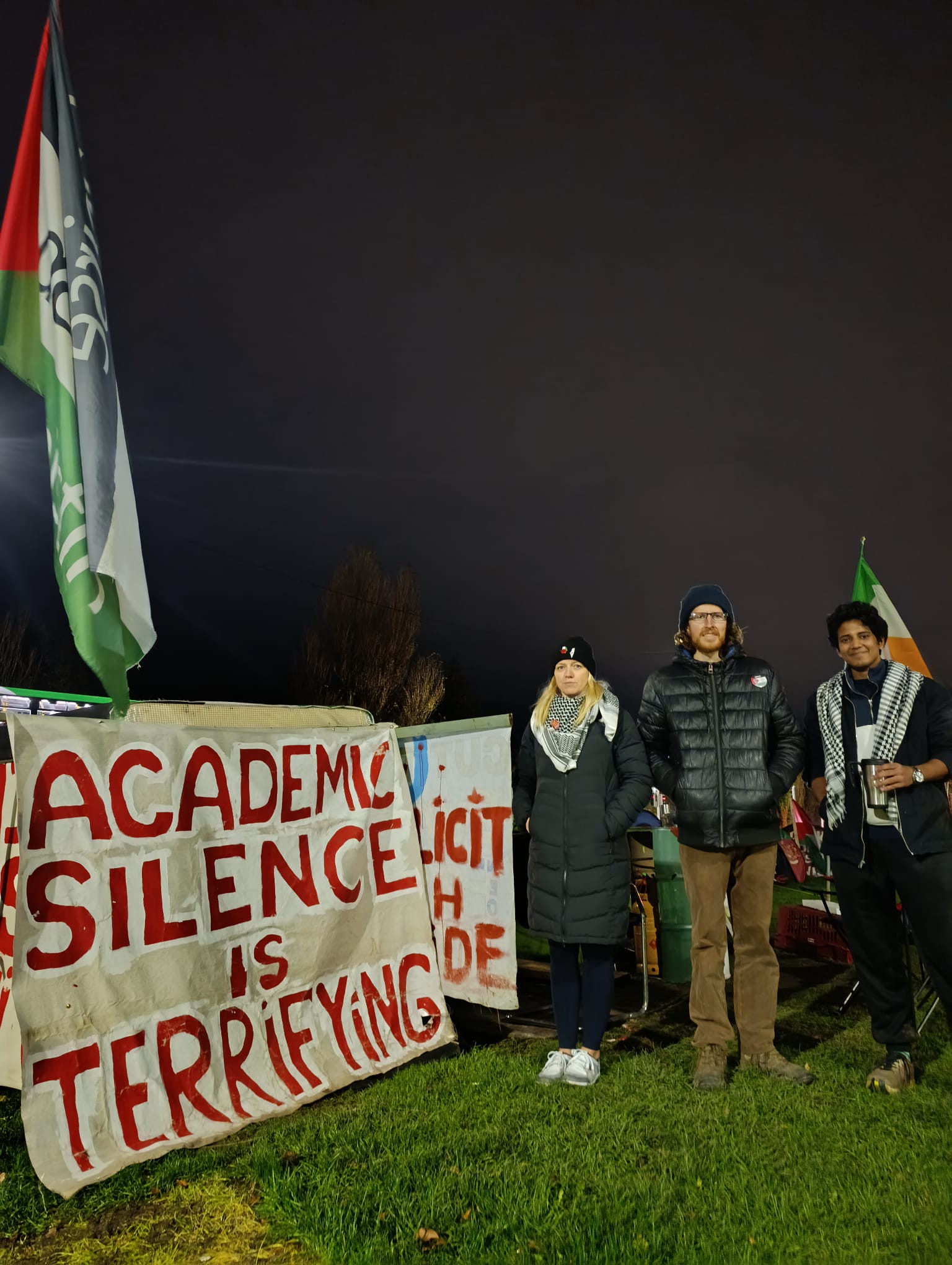
Róisín McAleer and Eoghan Harris
In 1937, Mao Zedong wrote that all genuine knowledge comes from experience. What, then, did we learn from the Break the Academic Chains of Zionism encampment?
We learned that freedom of speech does not exist as a universal right. It exists as a class-regulated function. Expression is permitted only insofar as it does not threaten state legitimacy or imperial interests. What democracy in the West presents as “free speech” is in reality a managed system of tolerance, where dissent is allowed only when it is symbolic, manageable or easily contained.
When those with different ideas organise sustained and materially disruptive protests, when their speech exposes complicity and demands accountability, it is met with repression. This is how the system functions under capitalism.
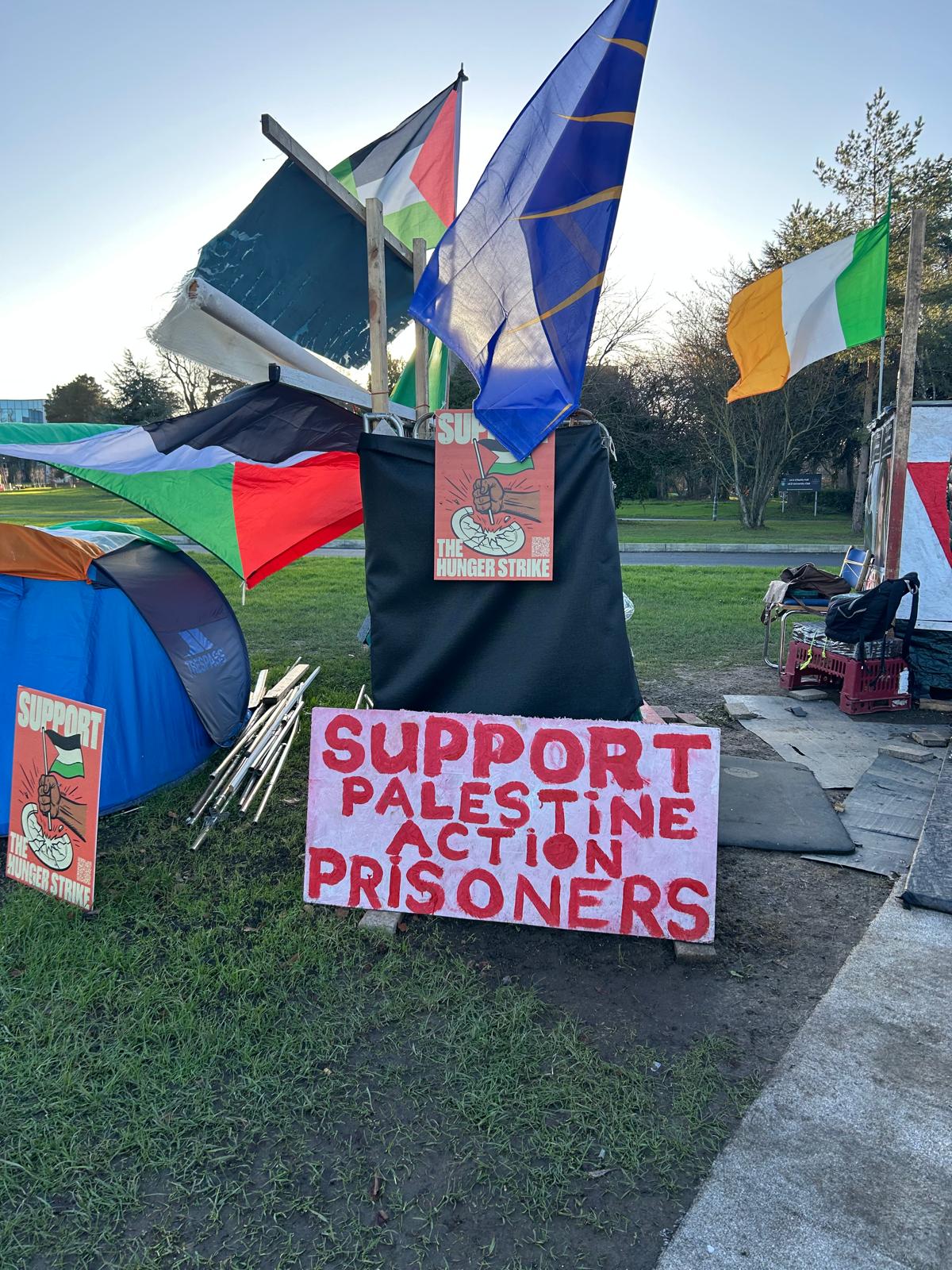
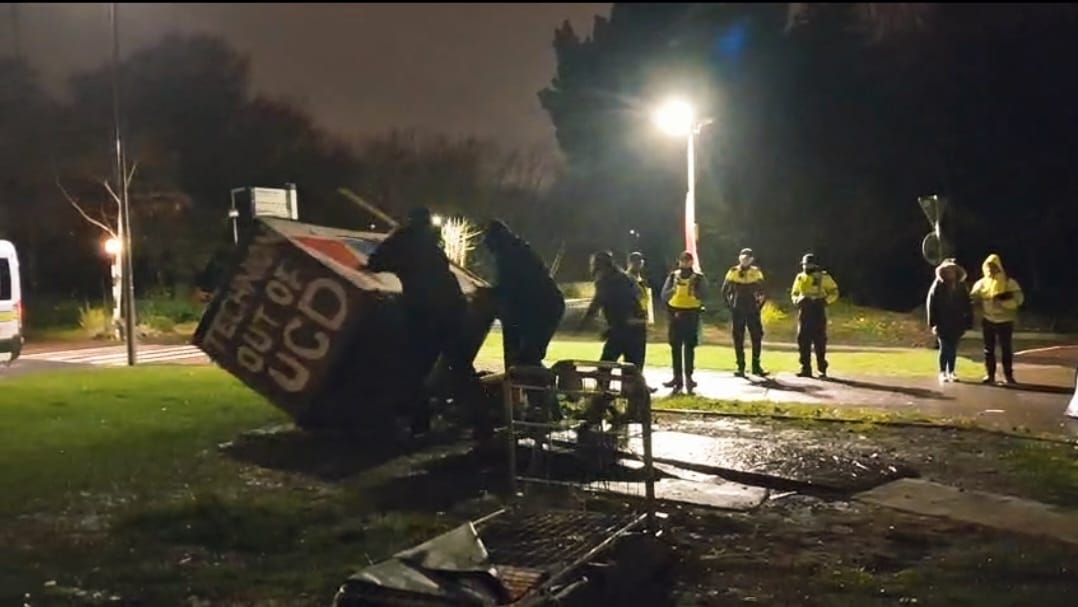
At 5.30am on the morning of 13 January 2026, this truth was made unmistakably clear. Ten members of An Garda Síochána, accompanied by a council official and a representative of a homeless service, arrived at a small mobile cabin constructed from OSB on Dún Laoghaire–Rathdown County Council land. This cabin housed our public protest against academic complicity in genocide. They came to dismantle it.
A young UCD alumnus, who had graduated only weeks earlier in December 2025, stood alone to defend the camp while other members who were organising on rotation were briefly resting. The timing of the operation was deliberate. It was carried out under cover of darkness because such an act is a matter of public shame: a violation of the fundamental right to political expression that could not withstand public scrutiny in daylight.
The encampment began 132 days earlier, in September 2025, in response to University College Dublin’s academic complicity with genocide —both passive, through silence, and active, through institutional partnerships with Israeli universities such as Ben-Gurion University and Technion, institutions deeply embedded in the Israeli military-industrial complex and the infrastructure of occupation and the economy of genocide. Our minimum demand was clear and modest: respect for international law, including the 1948 UN Genocide Convention. In practical terms, this meant an academic boycott of Israeli institutions guilty of war crimes. This demand is rational, lawful, and constitutionally legitimate.
But instead of dialogue, we were met with refusal. Instead of engagement, we faced repression. While institutions within sovereign states routinely claim to uphold pluralism and debate, UCD management responded with insecurity and desperation. Rather than addressing the substance of our demands, they attempted to invisibilize the protest—leveraging connections with local authorities, the police, and provocateurs, to marginalise and discredit our voices. Transparency was treated as an unreasonable provocation; even an agreement reached in a previous short-lived student encampment was withheld from public scrutiny. Accountability, it would seem, was framed as extremism.
One week previously, on 6th of January, a smiling Garda issued an eviction notice from the environmental department of Dún Laoaghaire Rathdown County Council. The letter made a case for eviction on spurious safety and environmental grounds. This was consistent with on-going efforts with UCD management to frame the protest as a homeless shelter. Letters to the council flowed in from supporters. Grounds for eviction were completely ludicrous as the camp was maintained on a rolling basis and nobody was or is homeless at the camp. Necessary facilities like cooking, washing, laundry was carried out in people’s homes. The timing was strategic as it was done just as people had gotten back to work but the week before students recommenced their studies. Despite this, the following day we assembled to show support for the camp with a group of 15 people, including one supportive local councillor who was subsequently dismayed to find out that the encampment had been destroyed without his knowledge a week later.
The council responded that the action would be “reviewed with applicable bodies including University College Dublin and An Gardaí Síochána”. No eviction notice was subsequently issued making the eviction illegal. The Garda’s smile of collusion and the bizarre classification of University College Dublin as a relevant body even though it was on public property, acquired an extra significance when we found out that the president of the University had been pressuring the county council. These responses expose the political role of UCD. Far from being a neutral space of learning, UCD acts as an ideological institution - protecting imperial alignments under the guise of academic autonomy.
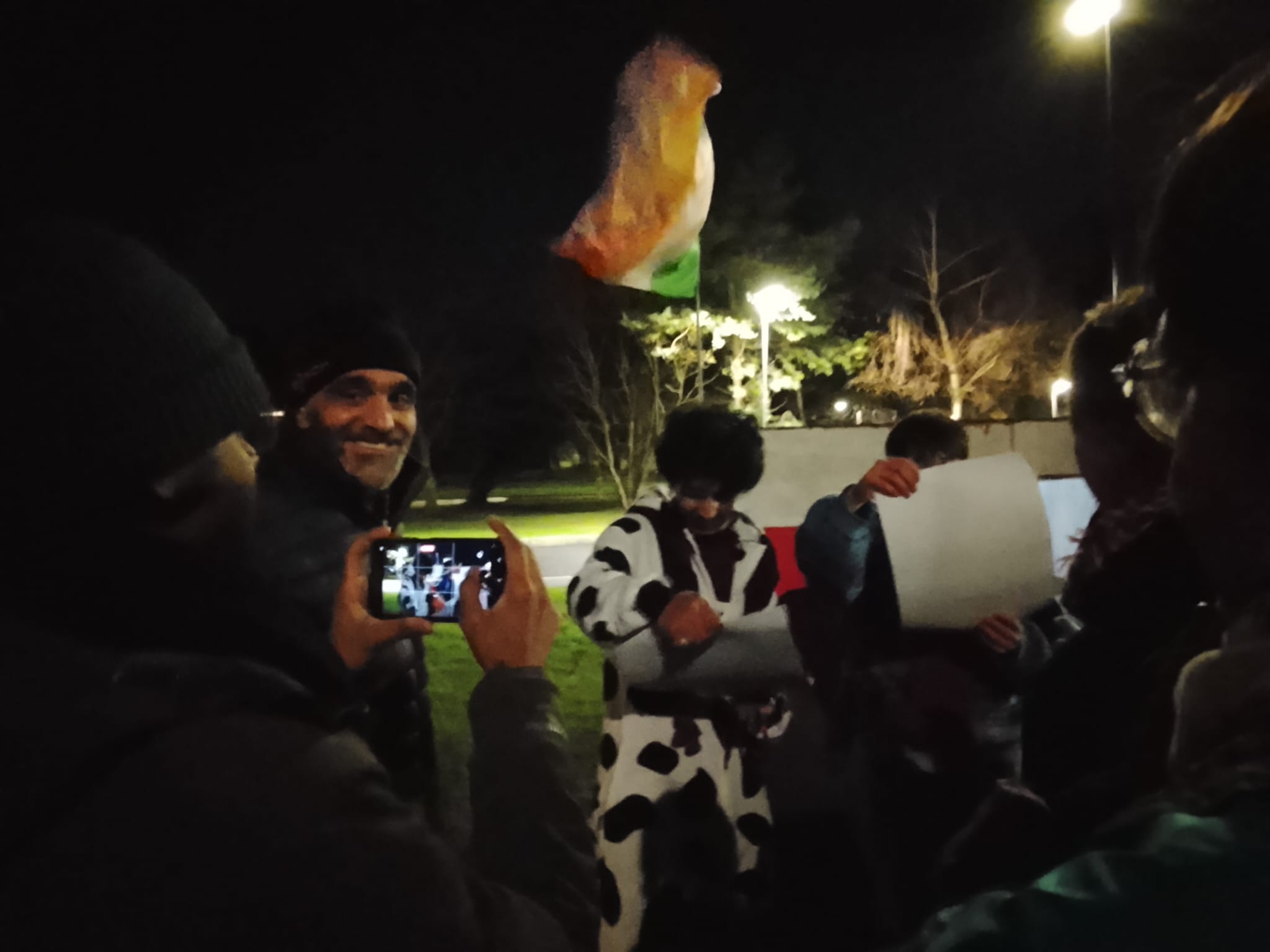
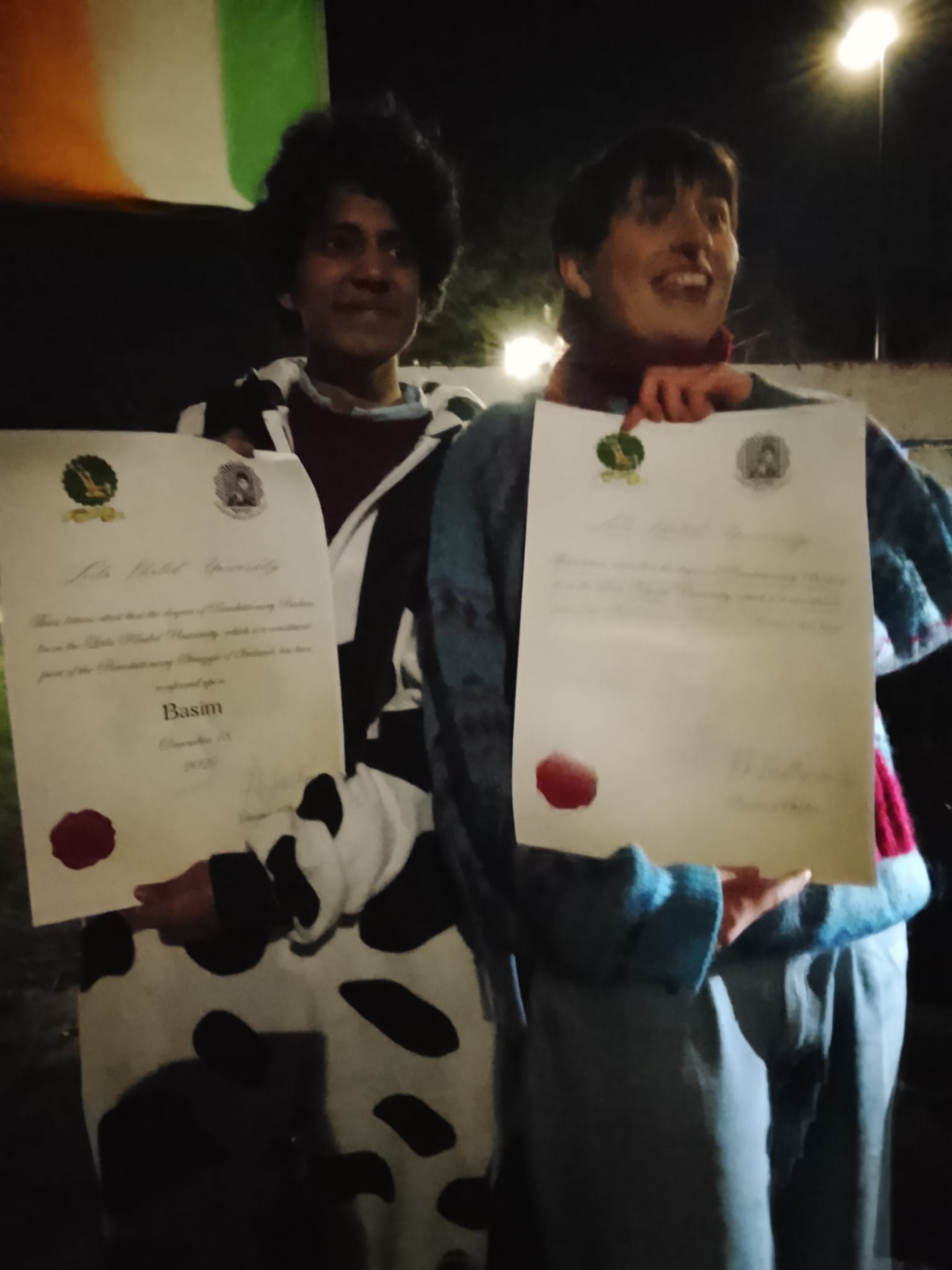
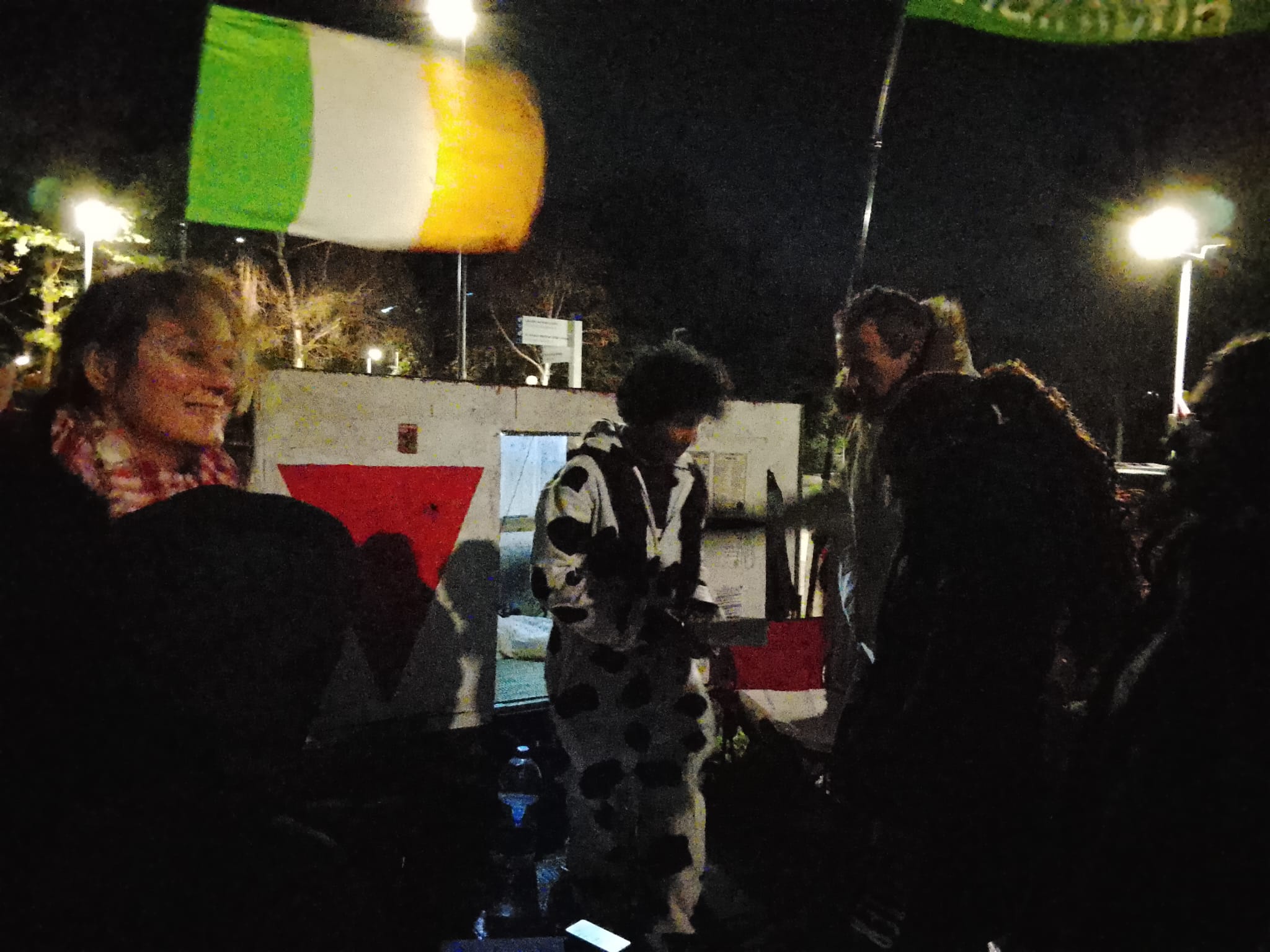
The encampment itself stood in direct contradiction to the caricatures used to justify its repression. It was open, peaceful, and rooted in solidarity. It respected differences of opinion while insisting on ethical responsibility. It was creatively and intellectually fertile: hosting assemblies, political education, engineering workshops, film screenings, art, music, and collective study. Some came to refer to it as “Leila Khaled University” — a space where learning was reclaimed from imperial discipline and returned to the people.
Despite this, two students now face disciplinary hearings in kangaroo courts designed to punish dissent. The university has threatened to withhold their academic credits. Enforcing obedience is the aim.
The financial facts further expose the lie. UCD’s partnership with Technion alone is worth approximately €4 million, funded through the EU Horizon project. The cost of surveillance, private security, and policing over 132 days is estimated at €1 million. If money were the issue, the partnership could have been quietly severed. Instead, extraordinary resources were deployed to defend it. What was at stake was not the funding, but political allegiance, ergo ties to Zionism that the institution just could not afford to lose.
We did not begin this encampment with illusions of victory. Revolutionary struggle does not measure success by instant concessions or getting small wins. Its task is to disrupt normality, to expose contradictions, and to shift consciousness.
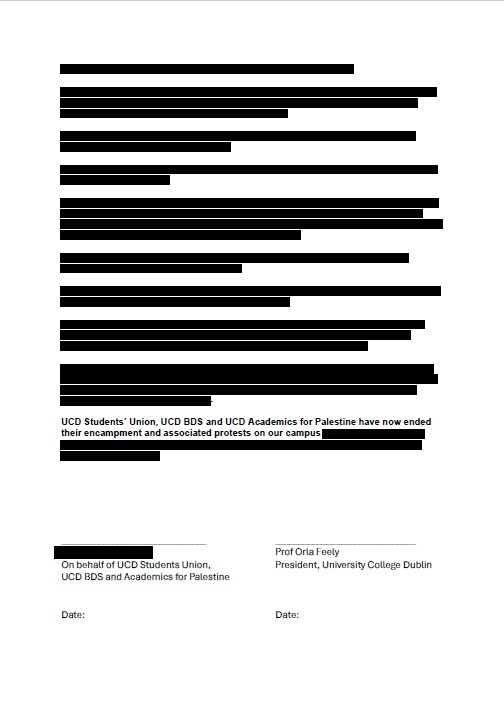
By that measure, the encampment succeeded. We learned through a Freedom of information request that an agreement signed at the previous encampment in 2024, fell well short of breaking any academic chains of complicity in the crimes of the Zionist regime. The agreement was signed by the Students’ Union, Academics for Palestine UCD, and
UCD BDS, which is mostly a People Before Profit front group, with no accountability or connection to the wider BDS movement. The name of the lead signatory was redacted. In fact, more than half the document was redacted. We do not know what is behind those black lines but we now know that those signatories signed away the right to protest for Palestine on campus. This is why some of the signatories really did not want us there.
The agreement of Summer 2024, hailed as a breakthrough by its signatories, is in reality a redacted capitulation, a neoliberal instrument of domination masquerading as a “win”.
We know that UCD management embedded itself into the 2024 encampment and can only speculate about their reason for capitulating to such an agreement. What is clear, is that the most effective tool of silent coercion in the modern university is the career path, and the system of rewards and punishments that it dispenses. This machine breeds dependence through specialisation, and the insecurity which is a constant feature of capitalism’s crises is turned into a tool of silencing.
The encampment fundamentally altered how many people now understand UCD and academia more broadly, both as active partners with genocidal institutions and the Western imperial war machine. When one brick is removed from a rotten wall, the structure does not immediately collapse, but it is permanently weakened. What once appeared stable is revealed as fragile.
The camp was violently dismantled on Tuesday morning. The repression over the course of five months was real. But the idea borne through 132 days of collective struggle did not disappear with the cabin. It moved. It moved into consciousness, into clarity, into history.
History does not advance through permission.
It advances through humans. And through rupture.