Tuesday evenings are bedlam in our house. Every evening is bedlamy in our house. Trying to put out the dinner, eat the dinner and clean up after the dinner while attending our Marxist-Leninist reading group with Joti Brar is not without its challenges. But by god is it worth it.
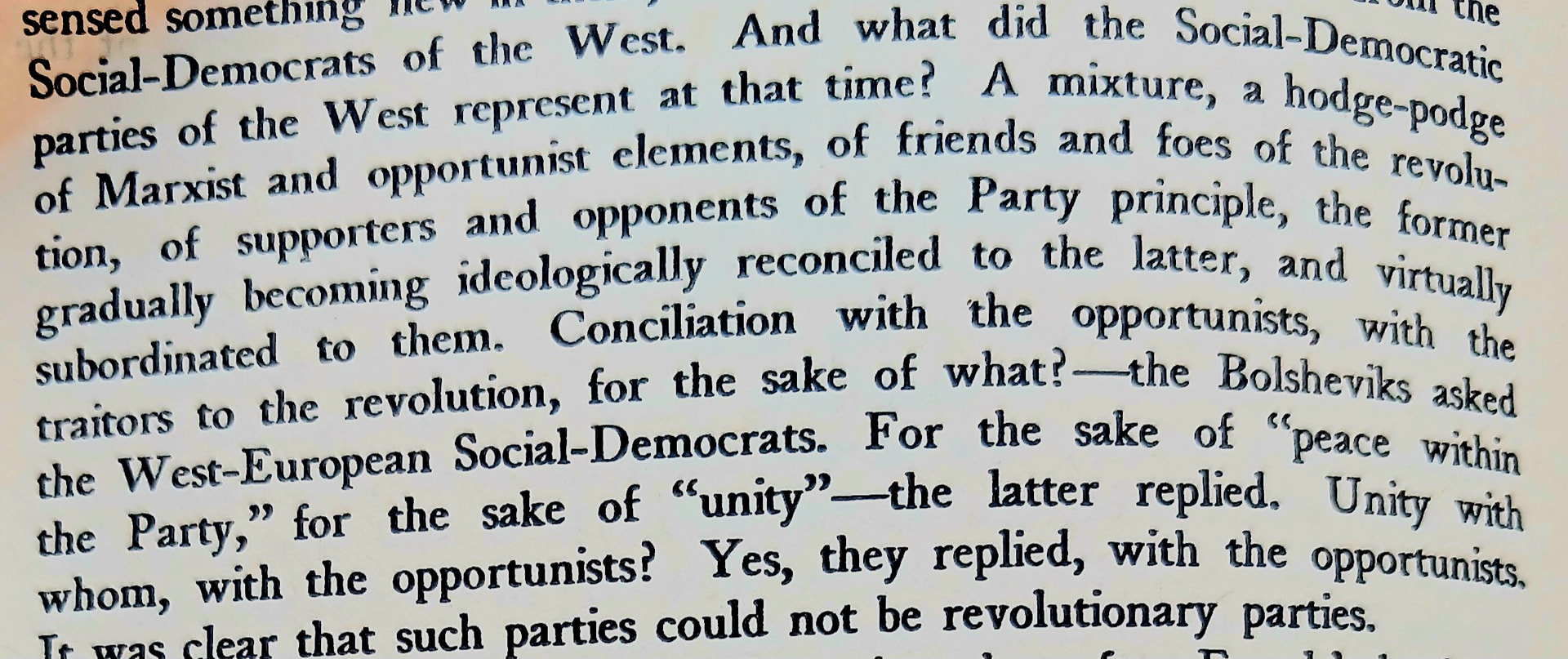
So, last night, we were on Chapter 4 of the History of the Communist Party of the Soviet Union (Bolsheviks) which covers the period after the Second Congress of the RSDLP, when the Bolsheviks were forging their identity against the Mensheviks and the opportunists. The discussion turned, as it has done often, to the question of unity. Unity with whom, and for what?
The Bolsheviks, as we learned, faced relentless pressure to compromise, to reconcile with the opportunists, to seek “peace within the party” at any cost. But they refused. They understood that unity with the enemies of revolution meant the death of revolution itself. They were building a new kind of party, irreconcilable toward opportunists, and revolutionary toward the bourgeoisie. The proletariat needed a party of social revolution, a party of the dictatorship of the proletariat.
The West-European Social-Democrats, by contrast, had degenerated into “hodge-podges” of Marxist and opportunist elements. Hodge-podge is such a great word, isn’t it! Plenty of that around today too. They swapped revolution for reform and let principle give way to popularity. As we know, the conquest of power for parliamentary respectability still exits today, in fact it is arguably stronger now. We learned how West European Social Democrats of 1912 called for “unity” back then, with the opportunists, and in doing so, they abandoned the working class.
As the discussion unfolded, I found myself reaching for a James Connolly quotation that had been sent me the day before. Talk about timeliness. In June 1899, the Workers’ Republic stated plainly:
“Socialism, as a party, bases itself upon its knowledge of facts, of economic truths, and leaves the building up of religious ideals or faiths to the outside public, or to its individual members if they so will. It is neither Freethinker nor Christian, Turk nor Jew, Buddhist nor Idolater, Mahommedan nor Parsee—it is only human.”
And in 1904, Connolly wrote in The Socialist:
“I have long been of the opinion that the socialist movement elsewhere was to a great extent hampered by the presence in its ranks of faddists and cranks, who were in the movement, not for the cause of socialism, but because they thought they saw in it a means of ventilating their theories on such questions as sex, religion, vaccination, vegetarianism, etc., and I believed that such ideas had or ought to have no place in our programme or in our party… We were as a body concerned only with the question of political and economic freedom for our class.”
The “faddists and cranks” of Connolly’s day have their counterparts in ours. The liberals, the academics, the NGOs, the progressive coalitions who come calling for “unity” while offering nothing but confusion, diluted principles and abandoned struggle. Their call for unity is ultimately a call for our subordination.
What often goes unspoken today, even amongst comrades, is the fear that drives this frantic pursuit of liberal unity. Many who lead these organisations, and even some who have attached themselves to the Communist movement, harbour a quiet terror of the working class itself. They fear the “great unwashed”… the raw, untamed power of ordinary people when they begin to move. They fear the chaos, the unpredictability, the refusal to follow the rules of polite society. They fear, most of all, the possibility that the working class might actually seize power and no longer require their guidance from their rostrums in universities and bookshops.
This fear is the hidden motor of the drive for liberal unity. By joining with liberals, diluting the party’s programme, and insisting on broad left fronts and coalitions that include everyone from trade union bureaucrats to NGO directors, to liberal academics, the revolutionary edge is blunted. The class struggle is displaced by social dialogue. The dictatorship of the proletariat is replaced by progressive reform. And the working class is kept safely, In. Its. Box.
The Communist party should be the vanguard of the working class. This is a big, and important responsibility, not a badge of honour, or entitlement. The vanguard does not follow the currents of public opinion. It should chart the course of revolutionary struggle. It does not seek popularity. This requires intellectual courage, and the willingness to stand apart (which is NOT the same as standing alone, to be clear), and to refuse the easy comforts of liberal respectability. It requires the hard work of Marxist analysis, the study of concrete conditions, and a strategy that can actually lead the working class to power.
Any call for liberal unity is a call to abandon this work. It is a call to take the path of least resistance, to avoid difficult ideological struggles and to substitute vague platitudes for scientific analysis. Knowingly or not, it is a call to betray the revolution.
The unity we seek is not with liberals who wish to preserve or tweak the system that exploits us. It is with the working class itself, those who produce the wealth of society and get pittance in return. It is with the organised and the unorganised, the employed and the unemployed, the native-born and the immigrant. This is the unity of the class struggle. It does not smooth over differences but sharpens them. As Connolly understood, the socialist movement has only one mission which is to break the chains that bind the workers of the world. Or as we say today, to break the chains of Zionism.
This brings us directly to the Irish Left unity project that every now and again gets touted. Its fundamental flaw mirrors the one we have just traced. The problem with it is that it chases scale while ignoring the question of revolutionary method. Clamouring for unity without first establishing a principled basis for it is not just a waste of time and energy, it is counter productive, and counter-revolutionary. Any movement that craves political influence without the grinding, unglamorous work of building working-class power, is doomed to fail.
Then there’s the calls for regroupment across activist groups. Even when its rhetoric invokes the working class, in practice it rarely touches the grass. The grass, it would appear, is too soggy. Especially in winter.
The socialist republican movement in Ireland is undoubtedly our best opportunity for creating, forging and stabilising alliances. It is in need of renewal. But renewal will not be achieved by stitching together more organisations and new activist groups under a broader canopy while leaving sectarian habits and opportunist methods untouched. It cannot be achieved by swapping worker organisation for electoral visibility, or by mistaking the intensity of activist circles for revolutionary capacity. Genuine transformation requires a clean break with idealism, moralism and sectarianism, a return to materialist analysis, and a disciplined, long-term orientation toward the organised working class as the only force capable of carrying through socialist change.
Any initiative that fails to meet this threshold should be met not with blanket hostility but with firm, comradely criticism no matter how grand its pronouncements or how broad its coalition.
These questions on unity versus alliances are not academic. They are the stuff of revolutionary politics. The Bolsheviks faced them, Connolly faced them, and now we face them today. The vanguard must reject the call to unity from liberals not out of sectarian spite but out of revolutionary principle. The working class deserves better than compromise and capitulation. The future of humanity depends on the victory of socialism.
Let the liberals have their coalitions and their photo ops at Stormont and Leinster House. For Palestine. For the Triple Lock. For Mother and Baby Survivors. For Travellers’ Rights. For Rent Freezes. For Shannon LNG. For School Places. For Fox Hunting. For SNAs. For Hospital Beds. For Bus Routes. Our job is to forge the weapon that breaks the chains. That is the unity we seek.