Róisín McAleer.
“I cast my heart into my rhymes,
That you, in the dim coming times,
May know how my heart went with them
After the red-rose-bordered hem.”
There is something in those lines that reaches across time. Struggle, sacrifice, passion and conviction are not meant to be sealed in the past, but understood and carried forward to today. As we mark Easter 1916, 110 years later, we ask, what is a revolutionary in Ireland today?
A revolutionary must begin from a clear premise. The national question remains unresolved. Our struggle for national liberation has never been settled, nor can it be settled by Britain, the EU, nor by the United States.
To understand the present we must study the past. The movements that produced Cumann na mBan, the Irish Volunteers, and the Irish Citizen Army aimed at rupture, a decisive break with imperial rule and class domination. What followed instead was a settlement. The Anglo-Irish Treaty delivered a Free State, while partition severed the country in two. However, the core structures of power north and south (ie property, class hierarchy, and external influence), all remained intact.
A revolutionary today does not approach this history as nostalgia. The task this Easter is not remembrance for the sake of remembering. It is recognition that the work of the 1916 revolution was left incomplete.
Perfidious Albion did not disappear after the treaty was signed, or after the counter revolution ended. British rule in the 26 counties adapted. In the north, its presence remains explicit. In the south, neocolonialism is masked by deep economic dependence, through a system integrated into imperial networks of finance, trade, and NATO alignment.
Imperialism no longer relies on military occupation alone. Its modern form is more pervasive, operating through markets, vulture funds, investment flows, tax breaks, and planning laws that suit US geopolitical alignment and interests. Decision-making has never been in the reach, never mind the hands of the workers in Ireland. It resides in Big Tech, Big Pharma, and in academia - in universities and institutions where obedience to and consent for imperialist interests come first, and lie outside the democratic control of the people of Ireland.
Opposition to imperialism today means confronting the conditions that deny real sovereignty, and confronting the institutions that normalise the Epstein class. That means confronting the housing crisis, precarious labour, and the erosion of our public services, not least our healthcare system, yes, but it must not stop there.
The revolutionary must expose how pacification operates — how “peace” agreements, brokered within imperial frameworks, set limits on what is considered possible. The absence of armed conflict is used to justify the continuation of control over us from Britain, the EU, and ultimately the US. Those who expose and challenge this are too often dismissed, marginalised, labelled.
But the question is not whether peace is valuable. It is whether the system we live under delivers justice, equality, and genuine peace and security. It does not. Thus, any serious challenge to the present system must therefore be rooted in class. Our working-class interests must form the basis of alliances and our anti-imperialist revolutionary memory must be invoked to give us the confidence to proceed.
Across Ireland, north and south of the border, the majority depend on wages that stretch less each year. Rising housing costs, growing food insecurity, precarious employment, and strained public services are the natural outcomes of the capitalist system organised around the interests of the few, rather than the needs of the many. Our material conditions are about to get a whole lot worse, and we must be ready to defend ourselves, from feeding ourselves to protecting ourselves from the servants and puppets of empire within, who will inevitably turn on us.
The revolutionary understands that change does not arrive from above. It is made collectively, through organised struggle. That means building within existing movements such as housing campaigns, and workplace organising. This is not new. But we especially and urgently need to build community resistance and defence. We must link immediate, short term demands to a broader political project, which is the creation of a sovereign, democratic, workers’ republic.
This requires more than protest, demos, meetings or electoral cycles. It demands organisation, discipline, and the development of leadership and defence rooted in our local communities.
One of the greatest barriers to this is engineered division within the working class. The tools of imperialism are used to fragment people along cultural and identity lines, obscuring our shared material interests. The result is a population encouraged to compete with, or fight each other, rather than unite. Without class unity, there is no path to structural change.
History offers clarity here, once again. During the Easter Rising, groups with differing ideologies acted together toward a shared goal. The cooperation between the Irish Volunteers and the Irish Citizen Army was not based on total agreement, but on a common purpose.
James Connolly understood that national liberation without social transformation would reproduce inequality. He also knew that division within the working class would undermine both. That lesson remains true today.
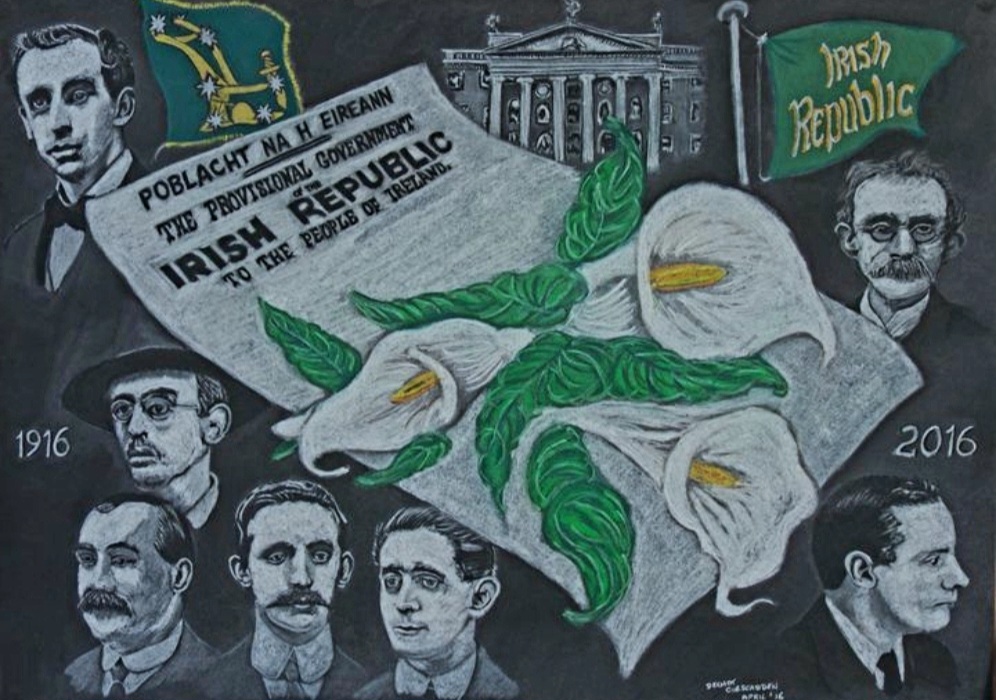
The legacy of 1916 is often reduced to symbolism. In reality, 1916 was an attempt to break fundamentally with British imperialist power and occupation. Figures like Constance Markievicz embodied a politics that linked national freedom with social justice, a connection too often diluted in official memory.
To read that moment in our revolutionary history honestly is to recognise the conviction, the willingness to act, the refusal to accept limits imposed from above. It is that intensity captured, in a darker tone, when the poet of the day warned that “the centre cannot hold.” That line resonates today as well. Imperialism cannot hold. It is straining, unstable, and lurching like a great dying beast toward its end. But it will not go quietly.
History is always instruction, but when will we learn?
There are many avenues for token reform in Ireland today via electoral politics, NGOs, advocacy etc. These can sometimes appear to achieve small improvements, but they cannot ever transform the underlying system of exploitation and inequality. Housing remains commodified. Workers remain subordinate to the interests of the ruling class. Economic power remains in the hands of empire.
Revolutionaries these days are thin on the ground, but they still exist and they are defined by what they do in practice, not what they say they will do next month, or next year. Educating, organsing and building collective power is key. Maintaining independence from structures that manage and control us and control dissent rather than enable transformation, is vital. Without the latter, the unfinished buisness of revolution simply cannot happen.
This is not easy work. It requires persistence, discipline, and discomfort. The revolutionary does not wait for favourable conditions.
Ireland remains embedded in an imperialist system shaped by US and Zionist interests. Economic policy, trade, and political alignment reflect this reality. Resistance, therefore, must also be internationalist and grounded in solidarity with struggles in Iran, Palestine, Lebanon, Venezuela, Cuba, to name but a few that are under direct attack from the Zionist dominated US regime.
So as we mark Easter 1916 in 2026, the question is not how we remember the past, but how we respond to the present. The revolution in Ireland is unfinished. The task is not to repeat history, but to confront what remains unresolved which is imperial control, via London, Brussels, and Washington. Republicans must move beyond symbolism, and toward substance in order to build a working-class anti-imperialist movement capable of real transformation.
Those who came before us cast their hearts into their words and their actions, it was not for admiration that our great heroes and martyrs fought and died for Róisín.
It was so that, in these dim coming times, we might decide what to do with what they began, so that all our children will be equally cherished, and so that we can all enjoy unfettered freedom, from the mucky plough to the silver stars.