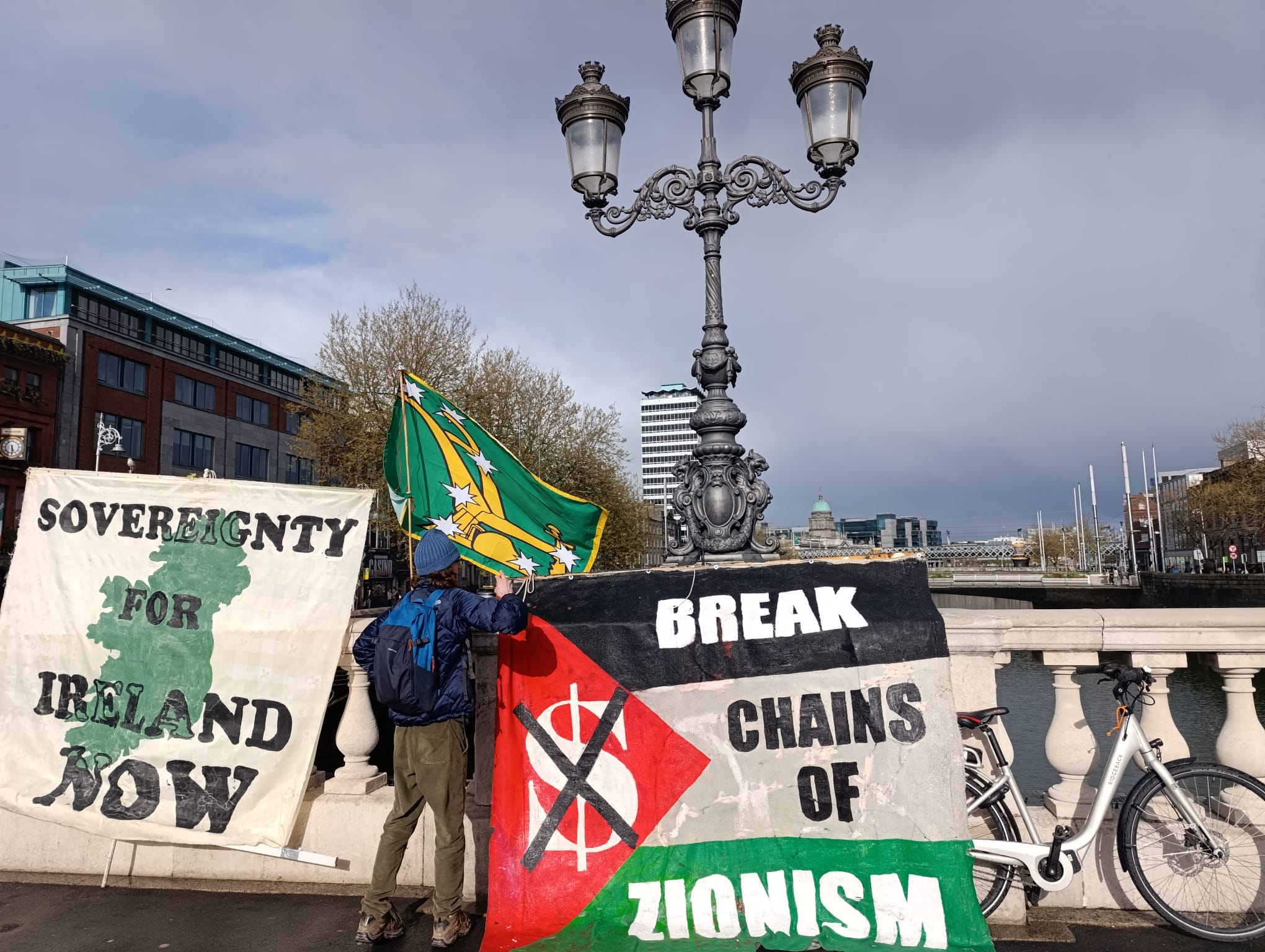
A common argument heard in Ireland by Palestine Solidarity groups is that our own anti-colonial struggle and history of dispossession, hunger, landlordism, and resistance compels us to stand with Palestine. This appeal to historical memory is powerful. It draws a direct emotional and political line between Ireland’s past and present, and it highlights that to remain silent is to forget who we are, and betray our identity.
Many people who hold this view are deeply committed to justice, and their instinct toward international solidarity is not misplaced. But this argument, while sincere, is ultimately insufficient for building the kind of working-class unity needed to challenge Zionism, and the cruel regime that produces both oppression in Ireland and Palestine, imperialism.
The limitation of invoking our historic memory lies in how the connection is made. By rooting solidarity primarily in shared historical experience and moral identification, the argument remains within an analogy that appeals to conscience rather than material analysis.
Ireland’s military, political, economic and academic chains to Zionism, and Palestine’s current conditions cannot be reduced to parallel stories of injustice. Relations of production, class structures, and their place within global Capitalism and Imperialism have shaped them. Without examining those dynamics, the comparison between Ireland and Palestine becomes symbolic rather than anti-Zionist, anti-imperialist, or indeed strategic.
When Palestine is presented as a moral duty, it obscures a more uncomfortable reality: why the Dublin Government aligns itself with dominant Zionist controlled Western imperial power structures in the first place. Contrary to liberal claims of “hypocrisy,” there is no real contradiction here. The Free State behaves as (vassal) states do within a global capitalist order, by adapting to the interests of capital and empire. It does not “forget” its history. It has selectively rebranded it.
This is where the discussion must become more honest, and forthright. The same establishment that invokes the legacy of Michael Collins in moments of national pride (such as the 1916 Rising), has over decades, worked systematically to strip Irish history of its revolutionary content. Collins is elevated as a symbol of statehood, while the deeper, more radical and revolutionary currents of Irish struggle are sidelined, sanitised or worse again, erased. It is no accident that figures like comrades Peadar O’Donnell and Liam Mellows and many more, including more recent revolutionaries like Bobby Sands for example, remain politically uncomfortable, not just because they represent resistance, but they embody a challenge to the legitimacy of the so-called “state” itself and the capitalist system it protects.
The result is an Irish population often taught a version of history that neutralises its own implications. Ireland is presented as being a republic. We are even told by pro Pal groups that we are neutral, and we must “save our neutrality” while warplanes land in Shannon and Aldergrove. Many ignore that we are a country partitioned, whose independence was never actually realised, north or south. The vassal state of 26 counties has integrated into a wider imperial core in all but name, while 6 of our counties remain occupied by British forces, perhaps more visibly chained to Perfidious Albion, but still referred to as “Northern Ireland” by brainwashed Free Staters who claim they are “free”.
Our revolutionary tradition has been reduced to heritage, commemorated in wonderfully rousing speeches while its lessons are ignored in practice. This nostalgia defangs the idea of revolution and replaces it with a safe narrative of national pride and progress.
The contradictions become stark when looking at contemporary movements. It is telling, and deeply revealing, to see some fuel or immigrant protest groups invoke counter revolutionary and tool of imperialism, Michael Collins too, while directing their anger in ways that remain disconnected from any analysis of class power or imperialism. The historical figures they cite are often abstracted from the material realities and conflicts they were part of, including the internal division within Irish republicanism itself created by British divide and conquer tactics, that triggered the counter-revolution.
At the same time, there is a parallel contradiction within sections of pro-Pal activism. Many are capable only of expressing solidarity in humanitarian terms, but hesitate, or outright refuse to engage with the realities of resistance, both historically in Ireland and presently in places like Palestine, Lebanon, and Iran. This creates a form of solidarity that is conditional, limited and dangerous. It confuses resistance with “violence” while ignoring the violence of empire that produces rightful, just resistance.
All of this feeds back into the central problem: the failure to build working-class unity. When solidarity is seen as a moral obligation or as historical empathy, it can feel alien or even irrelevant to those struggling with rent, mortgages, bills, jobs, family and to put it plainly - survival. For someone facing eviction, or waiting on life-changing or saving medical treatment, being told that Ireland’s past obliges them to care about Palestine today can sound disconnected from their immediate reality. And that’s the very gap where division grows.
The question, then, is not whether Palestine matters. It is more how we understand Palestine, and how we understand Zionism.
We need to move beyond moral appeals and toward material clarity. The same barbaric regime produces inequality at home. Why is the slow violence of homelessness, housing precarity, precarious work, and those suffering with severe mental and physical torture in Ireland so tolerated by so many in our Pal movement? The system that sustains genocide abroad is the same regime that slowly and silently kills far too many at home. These are not separate issues competing for attention. These are the chains of Zionism that must be broken.
Without that shift in mindset, activism risks remaining trapped in a reformist loop of appealing to Zionist puppet governments, invoking history, and expressing outrage, while leaving the underlying structures intact. Worse still, it allows the ruling class to continue shaping both memory and dissent, turning even resistance into something manageable and non-threatening.
If working-class unity is our goal,and let’s face it, it is the only way to break the chains, then the argument must go further. It must challenge not only genocide in Palestine, but the regime at home that people experience every single day. It must reconnect Irish history with its revolutionary content, rather than its free state-approved version. And it must make clear that international solidarity is not moral duty or charity, but a shared struggle rooted in our common material interests.
Only then can solidarity move beyond symbolic gestures and historic memory, and become something properly and effectively capable of confronting the Zionist regime itself, and its Epsteined class.