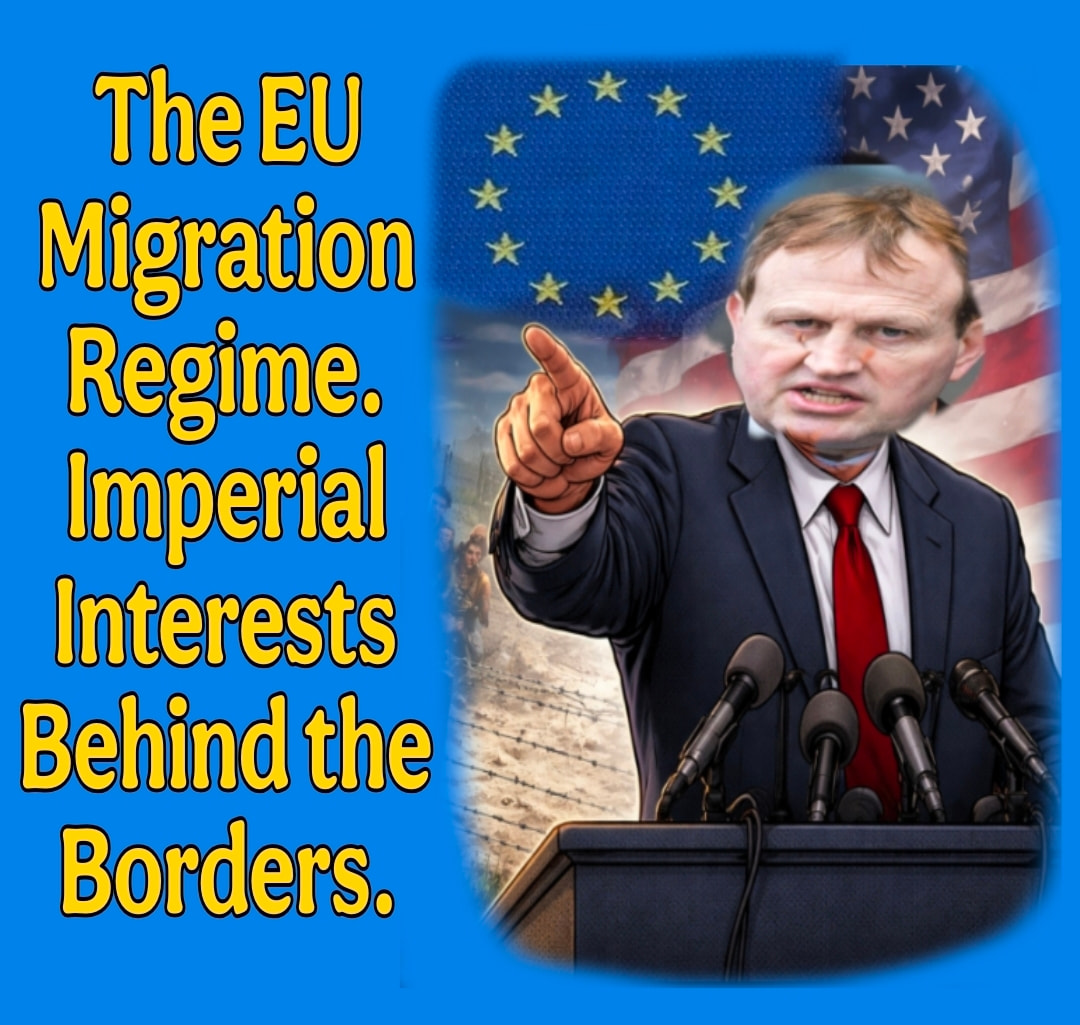
In Ireland’s online political theatre, every contradiction in EU migration policy gets reduced to a familiar two-sided performance. On one side, sections of the online right and lumpen commentary sphere have turned the Irish Foreign Affairs Minister O’Callaghan into a mad “commie” for administering policies that are structured at EU level and rooted in longstanding NATO aligned frameworks. On the other side, the self-identified left “Refugees are Welcome Here!” brigade exert their usual moral superiority without engaging the deeper structural questions of imperialism, labour segmentation, and the political economy of migration. Both reactions circulate around the same object of migration, but neither seriously confronts the barbaric system, or regime as we should say, producing it. Instead, they turn structural contradictions into cultural performance.
The EU’s migration policy exposes a clear pattern of differentiated treatment shaped not by universal humanitarian principles, but by geopolitical alignment and the material interests of imperialist and capitalist power. Refugees are not treated equally. Their reception depends on their perceived strategic, political, or economic value to European states.
When displacement aligns with US imperial geopolitical narratives, borders open, rights are fast-tracked and solidarity is loudly proclaimed, as we saw with the Ukraine war. When asylum does not align, those same borders harden. People fleeing wars tied to Western intervention, or pro-NATO regimes are met with detention and exclusion. A structured hierarchy of human mobility is the result, in which lives are categorised through the logic of capital accumulation, labour demand and geopolitical utility.
The EU’s approach reveals a system of managed inclusion and exclusion. Agreements with third countries, militarised border enforcement, and selective humanitarian responses all contribute to a model that stabilises the European core while displacing any values that the EU used to pretend to have. Migration is not only “managed” it is also actively organised in line with the interests of NATO and of capital and US impetialist strategy.
This contradiction is intensified in the EU Asylum and Migration Pact, which strengthens border externalisation mechanisms and accelerates asylum processing while further entrenching distinctions between deserving and undeserving migrants who are labelled legal or illegal, depending on their ability to prove their allegiance to the Western empire, and ergo NATO.
Opposition to the pact has emerged from both self-identified left and right-wing forces, but for fundamentally different reasons. The self-identified left often criticises its humanitarian deficiencies and legal restrictions, while the right objects that it does not go far enough in preventing entry or enforcing national sovereignty.
The irony is that both positions reject the same policy, yet neither does so from a class perspective. One critique tends to remain within a moral-legal framework that does not fully confront how imperialism and capitalism produce displacement and precarious labour in the first place. The other channels discontent into nationalism and exclusion, also redirecting frustration away from capital and toward migrants themselves.
Within this broader system, strategic labour mobility agreements such as the EU-India Common Agenda on Migration and Mobility highlight another layer of contradiction. Certain “economic migrants” are actively recruited, regularised, and integrated into European labour markets, while asylum seekers are subjected to deterrence and restriction. This raises the central question: why are some forms of mobility welcomed and institutionalised, while others are criminalised or obstructed?
The answer lies in labour segmentation under capitalism. Selective migration channels are used to regulate labour supply, wage levels, and sectoral shortages, while asylum systems are treated as security issues because they emerge from (engineered) crises that often reflect the destabilising effects of imperialist relations abroad. Migration policy thus functions not as a neutral system, but as an instrument for managing labour and reproducing capitalist relations on a global scale.
This differentiation also carries political consequences. By organising mobility through rigid categories of inclusion and exclusion, the system reinforces divisions within the working class itself. Such structures deepen identity-based or communal tension, rather than fostering class unity, by directing social frustration along lines of nationality, religion, or legal status instead of toward the underlying relations of production.
What emerges in Ireland’s public discourse is a compressed version of this larger system, distorted into online rants and division. A minister like O’Callaghan is labelled a “communist” in the imagination of the utterly confused who misread EU administration as ideological conspiracy, while others repeat slogans of welcome and open borders that ignore the structural filtering of who is actually allowed to arrive, stay, or work - and why. Both responses are equally bereft of serious political analysis.
The deeper reality is that EU migration policy is not a moral project but a material one. It is structured geopolitical strategy, and the management of inequality produced by global capitalism. Its contradictions are not accidental. They are functional, to serve the interests of the Epstein class.
The spectacle of Irish online debate is deeply depressing, particularly when we consider how attitudes of our young are shaped by social media. While one side shouts about imagined communism, the other about abstract solidarity, the actual machinery of migration continues to sort, select, and exclude according to the needs of capital and the interests of the ruling class. The online noise changes nothing, but it does sadly deepen working-class divisions and spread fear and confusion. Meanwhile, the structure remains the same, and the empire sits back and laughs.