On the 110th anniversary of the execution of James Connolly.
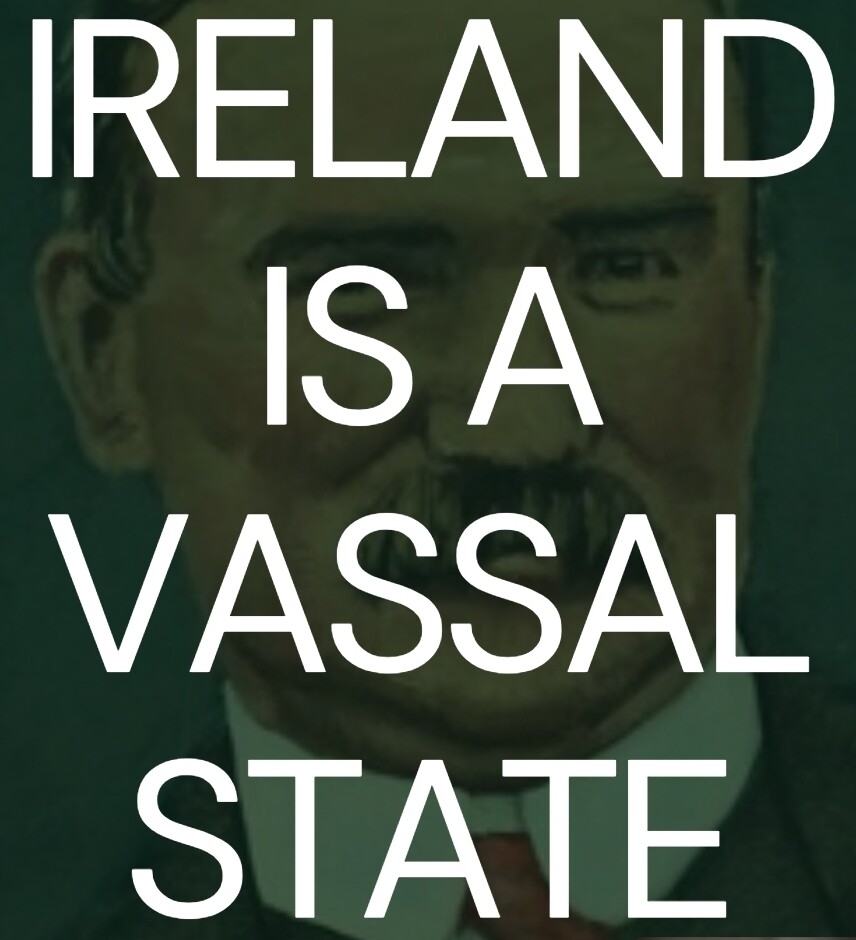
Connolly understood that national liberation without workers’ control over the land, industry, and our resources would only replace one ruling class with another. His prediction proved accurate. While the Crown was removed from administrative letters and postboxes were painted green, and the English military withdrew from twenty-six counties, the economic, political, academic, and cultural structures of colonial dependency remain very much intact.
The Free State that emerged after the revolutionary period preserved capitalist property relations, aligned itself with conservative social forces, and rapidly moved to marginalise radical labour politics in favour of so-called social stability. Through the combined influence of the Catholic Church, a cautious nationalist bourgeoisie, and continued British financial power, Ireland developed neatly and smoothly into a compliant peripheral economy within the broader U.S.imperial order.
The symbols of sovereignty were secured — a parliament, a flag, eventually the title of “Republic” — but the material foundations of genuine self-determination were relinquished. British strategic interests remained protected through partition, while economic dependency simply evolved into new forms. Today, the centres of real power across Ireland lie in big multinational corporations, foreign investment funds, pharmaceutical giants, and big tech conglomerates tied primarily to U.S. and European capital.
The right-wing political establishment in Leinster House that presents non-NATO friendly refugees as illegals and a threat to our “nation” simultaneously grants extraordinary freedom to international corporations exploiting our land, water, air, housing, and infrastructure. The seeming republic is deeply dependent on external capital flows, low-tax arrangements, speculative investment, and Zionist institutions in London, Brussels, and Washington
This subservience is maintained not only economically, but psychologically. Modern Ireland survives through the illusion of independence. The population is encouraged to emotionally identify with national symbols while material conditions steadily deteriorate. Workers spend enormous portions of their income on rent or mortgages paid to international investment funds that prop up the military industrial complex, sustaining the economy of genocide. Young people emigrate not for adventure to see the world before settling down, but because survival has become increasingly unattainable, unless you have a rich mummy and daddy who will put a downpayment on a house for you.
Public services are collapsing to the point where privatisation is seen as the only way out to save our hospitals, clinics, public transport, swimming pools, youthclubs, community centres, allotments and green spaces.
Everything that can be commodified, has been commodified. The deliberate underinvestment of pubic services happens while those in Leinster House continue to bend domestic policies around the political, military and economic interests of the Epsteined capitalist class. Yet despite growing alienation, we are constantly told that Ireland is prosperous, modern, progressive and successful. Toxic positivity has become a mechanism of social control. Anger and criticism are reframed as negativity. Structural suffering is reduced to personal failure.
The consequences of this contradiction are visible everywhere. Institutions speak endlessly about the mental health crisis, in our schools, in our universities, in our workplaces, in our football clubs, while simultaneously refusing to confront the political and economic conditions generating despair and alienation. The elephant in the room keeps getting bigger.
Childhood trauma, anxiety, burnout, addiction, loneliness, self-harm and suicide are discussed as isolated personal tragedies rather than symptoms of a society organised around precarity, debt, insecurity, and commodified human value.
According to provisional figures from Ireland’s Central Statistics Office, 302 deaths by suicide were recorded in 2023, alongside persistently high levels of self-harm presentations, particularly among younger people. A society that demands constant emotional performance while depriving people of a guaranteed place to call home… a society that no longer values stability, community, and meaningful control over our lives will inevitably produce exhaustion, despair and hopelessness.
Connolly understood something that remains politically dangerous today: a nation can remove the foreign flag while remaining colonised economically, culturally, and psychologically. A republic without workers’ power becomes little more than a shell. We are captured by capital and empire and independence is, and always has been, an illusion.
The greatest threat facing Ireland now is not one crisis over another, or corruption or inequality, or lack of accountability. The greatest threat is political passivity. The learned belief that no alternative is possible beyond managed dependency and permanent compromise is deeply ingrained, and most visible when we witness well-meaning activists begging for justice outside Leinster House, on an almost daily basis.
Then there’s the disciplining of those who speak uncomfortable truths about the present. The illusion of independence has pacified generations from resistance while the structures of imperial power have adapted and modernised, becoming more subtle and sophisticated. When those who dare demand that the chains of Zionism are broken, or who draw attention to rising fascism in Germany are removed from Palestine solidarity spaces, one must ask, who are these approved activists loyal to?
Had Connolly survived 1916, Irish history may have developed along a radically different path. Unlike many nationalist leaders of his time, he recognised that political sovereignty without socialism could never liberate the working class. A surviving Connolly may have pushed the republican movement toward workers’ councils, industrial democracy, land redistribution and genuine economic independence resistant to domination from London, Brussels, Washington, and international finance. Such a movement might also have challenged sectarian division itself by reorganising politics around class struggle rather than religious identity. Instead, Connolly’s death represented not only the loss of a revolutionary socialist, but the defeat of an alternative future for Ireland altogether.
And despite the vassal state we have been born into, Connolly’s relevance endures because the conditions he warned against have not disappeared — they have worsened. Our work is to no longer preserve comforting illusions about an “independent republic”, but to honestly confront the realities of dependency, alienation and Zionist controlled imperial subservience, integration and indeed ingratiation that define modern Ireland.
Survival through illusion is not liberation. A society made materially insecure and psychologically exhausted by capitalism cannot transform itself through sentimentality alone.
Truth, however uncomfortable, remains the beginning of political clarity. Ireland is a vassal state.