Róisín McAleer
Among sections of the self-identified Irish left, a depressing formula has taken hold: “If we don’t believe we will win, we should not take direct action.” It is presented as pragmatism. It is defended as realism. In practice, it is paralysis dressed up as strategy.
This line has sadly surfaced at some local Neutrality meetings we have attended. Opposing EU militarisation and Ireland’s deepening integration into NATO-aligned structures is an important struggle that certainly has the potential to build working-class unity and local assemblies. However, when a call for more direct action and organising was proposed by local people in the community, the response from two elected independent local councillors was negative, under the mantra: no action should happen without prior approval, without guaranteed success.
But what is “success” in class struggle? An immediate institutional concession? A policy amendment?
Struggle is not a sequence of pre-approved victories. It is the ground on which consciousness is forged, revolutionaries are trained, and contradictions are clarified.
A protest that wins no immediate concession can still:
Raise class consciousness
Develop organisational discipline
Clarify political lines
Expose reformist hesitation
Shift ideological ground
To refuse or discourage action unless a liberal definition of “victory” is secured in advance is to accept bourgeois criteria for legitimacy. It reduces politics to lobbying and transforms revolutionaries into managers of discontent.
If we fight only the battles guaranteed to succeed, we will never build the capacity required to win those that matter.
Irish revolutionary history offers no comfort to those who demand certainty before action.
Those who participated in the Easter Rising did not act under illusions of guaranteed victory. The British Empire was formidable. The balance of forces was unfavourable. Yet the leaders understood that struggle itself transforms political reality.
Patrick Pearse did not wait for favourable polling data. Bobby Sands did not undertake hunger strike because success was assured. None of them demanded pre-certification of victory.
By the way, this is not a call for romantic martyrdom. It is a recognition that no colonial or neo-colonial people has ever advanced without sacrifice. Discomfort, repression, and uncertainty are all features of confrontation with power.
Today, however, we encounter a softer politics. At encampments and occupations, anxiety about sleeping arrangements can eclipse discussion of strategy. Institutional backlash becomes more frightening than institutional injustice. Reputational risk looms larger than political retreat.
There is a difference between caring for comrades and centering comfort. Revolutionary discipline requires organisation and mutual care, but also endurance. If we recoil at inconvenience, we train ourselves in passivity.
The generation of 1916 was not born courageous. They were shaped by struggle. Courage is produced through collective commitment, not comfort.
And a further contradiction persists. Some who mocked the UCD Break the Academic Chains of Zionism encampment demands which included free education, housing, healthcare, transport, and food as “utopian” simultaneously invoke Connolly’s declaration that “We only want the Earth.” Maximalist slogans on t-shirts combined with refusal of concrete struggle constitutes abstraction.
Our insistence on transitional demands are because such demands can:
- Unite broad sections of the working class
- Expose the limits of capitalism
- Reveal the antagonism between labour and capital
- Build organisational capacity
Connolly did not counterpose daily material struggle to revolutionary transformation. He rooted revolutionary politics in it. To sneer at immediate demands while celebrating distant total transformation reveals disconnection from mass struggle.
Another symptom of strategic confusion is misidentifying the principal enemy. Reactionary street formations are dangerous. But to elevate them above imperialist militarisation, neoliberal restructuring, and the dictatorship of Zionist controlled finance capital is to mistake symptom for structure.
Imperialism is not an attitude. It is a material system. The Free State is embedded within EU-led capital accumulation and US-aligned geopolitical structures. It is, put simply, under the Zionist thumb. Housing crisis, healthcare collapse, and militarisation are not products of every person that the liberal left calls “The Far Right”. Our political, economic, and social problems are inevitable systemic outcomes of capitalism. Fascism comes from capitalism. Not from Coolock. Not from Sandy Row. No. Fascism was not born in our estates. It is in universities and embedded in NGOs. It is tucked neatly behind the leafy gated homes of the billionaires. So go there, if you want to finger point and kick ass. Leave our estates alone. We can manage without the lectures, fear mongering and moral posturing, tanx and fanx, v much.
Because when politics becomes moral finger pointing of individual “racists” on our roads, while leaving the structure intact, struggle is displaced into spectacle.
Without structural and material analysis, that kind of “politics” is simply not anti-imperialist, never mind principled.
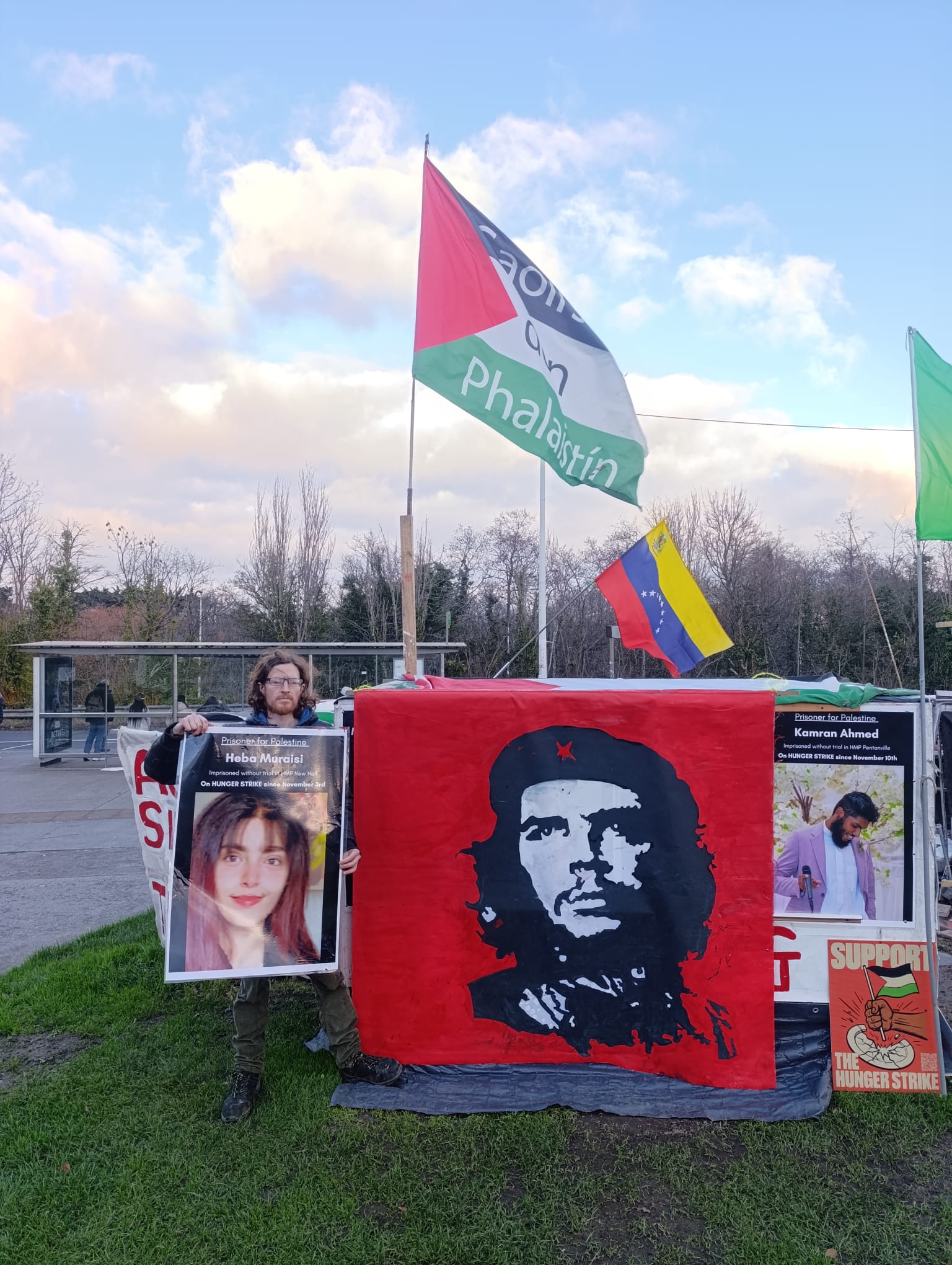
When the 132-day “Break the Academic Chains of Zionism” encampment at University College Dublin was dismissed as “doomed to fail,” by some, what was revealed was not strategic depth, but fear.
Encampments, strikes, occupations, these are schools of struggle. They create thinkers. They forge new networks. They reveal the alignment of institutions with Zionist imperial interests.
To dismiss action because it may not immediately force capitulation is to reduce politics to petitioning. The mantra “no action without guaranteed success” assumes:
- The masses are not ready
- The balance of forces is fixed
- The state is immovable
- Failure discredits
But the balance of forces is not static. It shifts through engagement. Every retreat from action reinforces passivity. Every disciplined confrontation builds capacity.
Revolutionary optimism is not belief in automatic victory. We are not so naive. It is confidence in knowing that only the organised masses can alter conditions through sustained struggle.
Therefore, to revive genuine revolutionary consciousness we need to:
- Re-center imperialism and capitalism as principal enemies.
- Link maximalist vision to material demands.
- Treat struggle as political education.
- Reject paralysis disguised as realism.
- Build independent working-class organisation and local assemblies beyond parliamentary limits.
Marxism–Leninism is not the politics of guaranteed outcomes. It is the politics of organised risk. No ruling class relinquishes power because victory was pre-approved. Power concedes nothing without struggle and struggle is never certain.
Respectfully, dear local “independent” councillors, the question is not whether we the working class people can guarantee a win.
The question is whether we are prepared, and indeed, encouraged to build the working class forces capable of overthrowing this normalised barbaric and cruel system.