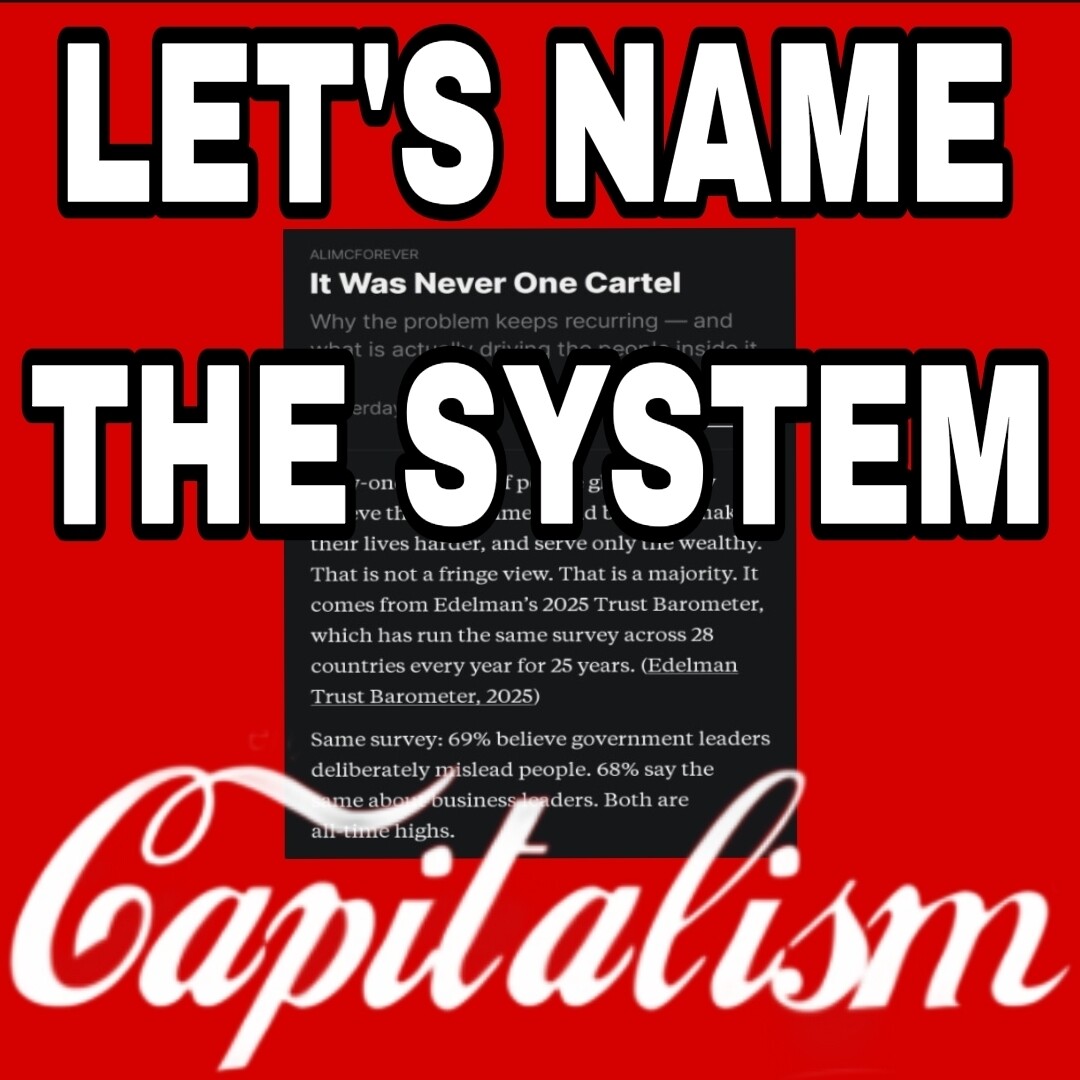
AliMcForever has blasted onto our social media spaces with aplomb. She is certainly making an impression on new activists, especially those who are new to questioning the status quo.
Her piece yesterday 3rd July 2026, entitled ‘It Was Never One Cartel’, is a timely article written when public distrust in governments has reached historic levels. Drawing on the 2025 Edelman Trust Barometer, she notes that 61% of people globally believe government and business make their lives harder and serve only the wealthy; 69% believe government leaders deliberately mislead; 68% say the same of business leaders. She understands that the masses understand something is seriously wrong.
Ali’s diagnosis is incorrect, however. She is close, and knows that the problem is coming from somewhere other than governments, and correctly identifies the Rothschilds, BlackRock, Epstein’s network, the Bilderberg Group. She identifies the problen as “cartels”. That is not the only mistake. Ali fails to identify the cartel-forming tendency itself. Cartels form, dissolve and reform constantly across every industry that controls something people need be they chemicals, music, oil, housing, pharmaceuticals, sport, content distribution. The structure recurs because the conditions produce it.
This is quite insightful but it does not go far enough. Ali explains how cartels persist through psychology (anxiety, moral disengagement, diffusion of responsibility, false consensus) but she never answers the fundamental question: WHAT is the SYSTEM, and WHY does this system exist in the first place?
Ali’s framework is flawed because it is fundamentally idealist. She locates the driver of cartelisation in individual psychology: anxious executives with overactive threat-detection systems, scarcity mindsets running on full volume, neural reward circuits reinforcing hoarding behaviour. The cartel builder is presented as someone trapped by their own neurology, acting out a trauma they cannot escape. This is a seductive story. It is also wrong.
Anxiety does not produce cartels. It is CAPITALISM that produces both the cartels and the anxiety. The motive of profit compels concentration of capital. Competition creates pressure toward monopoly as the only stable equilibrium. And private ownership of the means of production gives capitalists the power to restrict supply. The “anxiety engine” Ali describes is a superstructural phenomenon, a psychological reflection of real material conditions, not their root cause.
Ali’s own evidence disproves her framework. She notes that the Nuremberg tribunal convicted thirteen IG Farben executives in 1947, yet all were out of prison by 1951, and Fritz ter Meer, who was convicted of running a slave-labour facility at Auschwitz, was chairing Bayer’s supervisory board by 1956. If the psychology of the individuals were the driver, removing them should have changed things but it didn’t. The position of the executive chair, the market share, the profit margin all forced the next person to do the exact same thing.
Unfortunately, many liberals who are now beginning to be impacted by imperialism and capitalism also know that something is wrong, but still don’t realise that you cannot therapy-treat a system.
The most glaring absence in Ali’s analysis is class, which is sadly recurrent throughout her work. She treats cartel participants as generic humans suffering from a shared neurological condition. This erases everything that matters:
Q. Who owns the cartels? A. The capitalist class, specifically, finance capital.
Q. Who is exploited by them?
A. The working class, globally.
Q. What is the relationship?
A. Extraction of surplus value through monopoly pricing, wage suppression and rent-seeking.
Ali never mentions workers, renters, unions, strikes or resistance in this article, and rarely does elsewhere. The working class is entirely absent from her account. This can’t be an oversight, can it? It appears to be a political choice. By universalising the psychology that “humans are coalition animals,” she ignores the fact that 99% of humans form coalitions to survive, while 1% form coalitions to dominate. The working class forms unions; the capitalist class forms cartels, to use her phrasology. Treating them as the same biological impulse is a category error that obscures who is exploiting whom.
The cartel is a class instrument, something that class conscious readers may be able to deduce, but, liberal readers, probably not. The cartel functions to depress wages by controlling markets, raise prices on basic necessities (housing, food, medicine), and block innovation that would threaten Zionist profits. Ali’s framing of “anxious people acting out their trauma” transforms organised class exploitation into individualised pathology. This is not proper, scientific analysis.
Ali also mistakenly argues that the elite are trapped by a false scarcity mindset, creating real scarcity for others. The cartel restricts access to resources not because they are genuinely scarce but because scarcity generates price, price generates control, and control quiets the alarm. If they are trapped, who benefits? The elite do. They get the islands, the yachts, the political power, the global influence. Their anxiety might be real, but their objective material interests are served by maintaining the cartel. The working class gets nothing but higher prices and lower wages.
By focusing on the subjective feelings of the elite, Ali invites us, albeit subtly, to sympathise with the individuals in cartels. We reject this framing and encourage Ali and people like her to focus on the objective reality of the worker who cannot afford rent or meds. The elite’s anxiety is a problem for their therapists. The worker’s starvation is a problem for the revolution.
Ali uses a powerful metaphor: “You can dissolve one whirlpool. The shape of the riverbed makes another.” She is right that removing individual cartels without changing the conditions that produced them generates another. But she never defines what the riverbed is. We can and should define it precisely.
· Private property in the means of production.
· The wage-labour system (workers must sell labour to survive).
· The capitalist state, which enforces contracts and property rights with violence if necessary.
This is why reform fails. Antitrust suits (Standard Oil in 1911, AT&T in 1984, Microsoft in 2000, Google now) only temporarily break monopolies. They re-form within a decade because capital will always flow to the lowest regulation, the weakest enforcement, the most pliable state. You cannot “regulate” away the impulse to form a cartel when the alternative, i.e., competition, means bankruptcy and ruin for the capitalist.
The only way to permanently change the riverbed is to remove the profit motive entirely. To socialise ownership so that resources are managed by the collective, not extracted for private accumulation.
Ali goes on to cite Bandura’s “moral disengagement” and diffusion of responsibility to argue that cartel actors don’t feel like they are doing harm. But she also admits that IG Farben executives knew about Auschwitz. Tobacco lawyers knew about the cancer in 1953. If they knew, it is not an unconscious neurological alarm. It is a calculated risk assessment. They weighed the profit against the human cost, and chose profit. Calling conscious decision-making a “neural threat-response” is an ideological shield. It turns war criminals and price-fixers into patients. We should be holding the ruling class accountable for their choices, not excusing them as “anxious,” otherwise we end up letting them keep doing it.
Is Ali’s piece shit? No. Is it not worth reading? No. It is valuable for its documentation, as are many of her pieces, but the analysis is unfortunately ideologically bankrupt for its conclusions. She describes the world accurately in its empirical details and then draws the wrong political conclusions from that description. It is a textbook example of what Lenin called “objective idealism,” which is the tendency to present material facts and then explain them through idealist categories.
The Edelman Trust Barometer tells us that the majority of people know something is wrong. They know government and business serve the wealthy. They know leaders lie. They know the system is rigged. Ali is telling them it’s not one cartel, it’s many, and the people running them are anxious.
As working-class anti-imperialists, we know that the cartels are the organised power of capital. They must be smashed, not understood, not therapised, not reformed, but destroyed, along with the system that produces them.
The riverbed (Ali’s term, not ours) is capitalism. The only way to stop the whirlpools is to dynamite the riverbed.
On a lighter end note, another reason why we should absolutely name the system for what it is i.e. capitalism (and not a riverbed) is so that we target the real enemy, and not actual riverbeds!