We live in a world where before facts are even examined, language is used, as an insidious weapon to create and determine (often moral) legitimacy and consent for U.S. imperialism.
The empire does not only depend on missiles, sanctions, or its 877 military bases around the world. It also relies on language. Words repeated through newspapers, television, and entertainment platforms shape how the masses interpret world events long before they examine the facts themselves. Through repetition, certain terms become common sense, appearing innocuous while quietly reinforcing the worldview of U.S. imperial power.
Most politically aware people understand that large media institutions such as CNN, BBC, and RTÉ operate within political and economic structures aligned with Western geopolitical interests. Yet even activists who recognise this often repeat the same vocabulary those institutions popularise. This reveals a deeper problem. Language itself functions as part of the ideological superstructure that protects imperial domination, and we, who are involved in anti-imperialist education, have our work cut out.
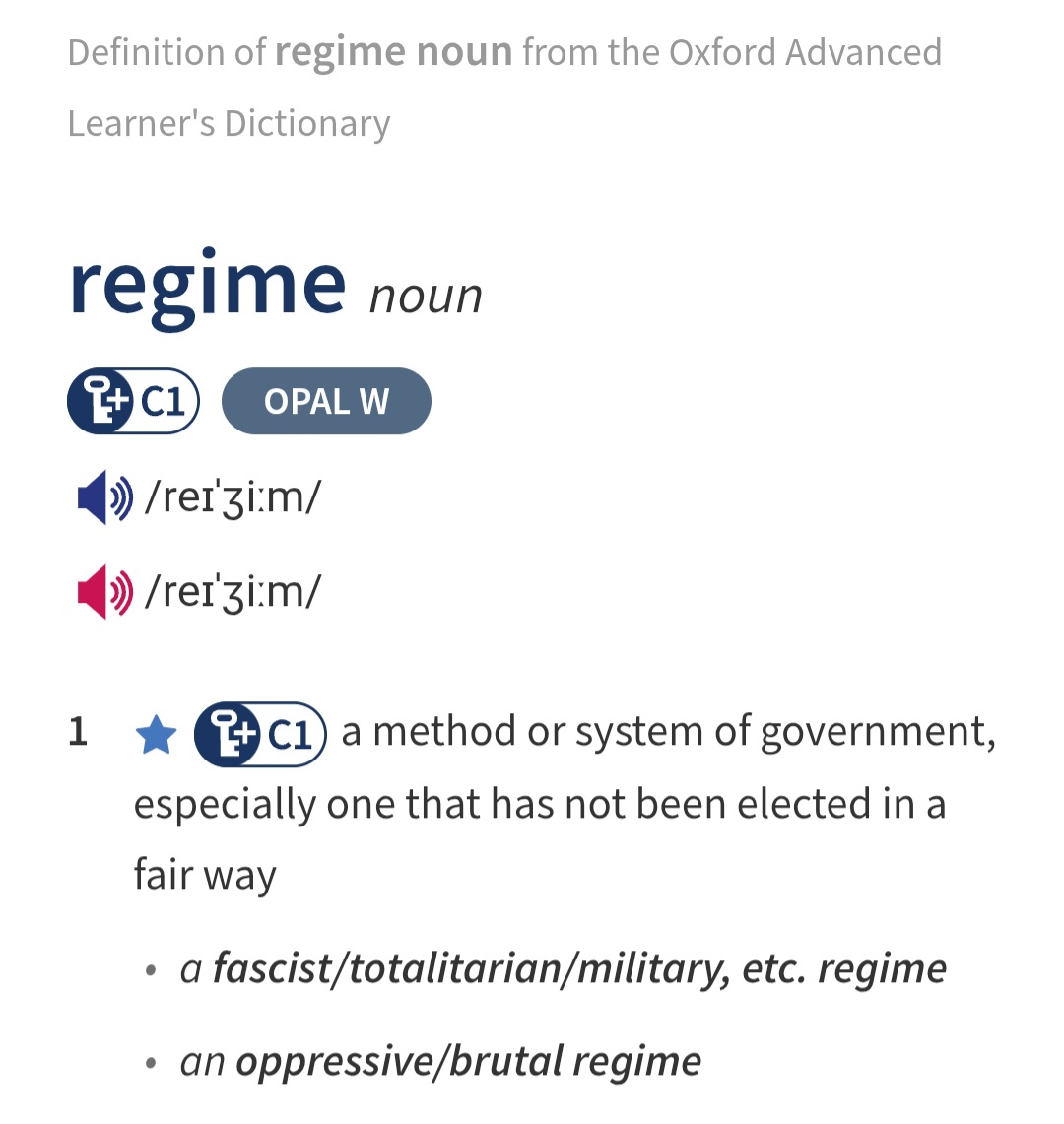
One of the most common examples of word dysmorphia is the word “regime.” Western governments are almost never described as regimes. Instead, the term appears almost exclusively when discussing states targeted by U.S. Western pressure: “the Iranian regime,” “the Assad regime,” or “the Venezuelan regime.” The word subtly signals illegitimacy and repression. By contrast, allied governments, regardless of their democratic credentials, are described as “administrations,” “partners,” or simply “governments.” Before any political analysis begins, the linguistic frame has already established who is presumed legitimate.
Closely related is the selective use of “dictator.” Leaders who oppose Western geopolitical interests are routinely labelled dictators regardless of the structure of their political systems. Meanwhile authoritarian allies are softened into “strongmen” or “strategic partners.” The label performs ideological work, if a leader is a dictator, sanctions and intervention appear morally justified.
Language also performs subliminal cultural othering. Western media references to Iran often rely heavily on the title “Ayatollah.” While it is a legitimate religious designation, its repeated use as a political shorthand reduces a complex state structure to a caricature of religious fanaticism. It reinforces the narrative that Western governance represents rational modernity while its opponents represent irrational authority.
The same pattern appears in how media describe armed movements. Notice how the Axis of Resistance is always framed as “militants” or “terrorists,” while insurgencies aligned with Western interests are frequently called “resistance” movements or “people’s revolutions.”
And the lofty word, Democracy is also synonymous with alignment with Western geopolitical interests rather than a consistent political standard. Human rights violations by U.S. adversaries dominate headlines, while abuses by allies receive far less attention. Freedom is frequently invoked to justify military intervention or sanctions, even when such policies devastate civilian populations.
Other terms operate more subtly. Words such as “civilised” reproduce colonial hierarchies by implying that some societies represent modern progress while others embody backwardness. The rhetoric of being “inclusive” often reframes geopolitical conflicts as moral disputes about tolerance, shifting attention away from material questions of class, resources, and imperial domination. Finally, the word “authoritarian” functions as a broad label applied to states that challenge Western hegemony, simplifying complex political systems into a single moral category.
Ireland itself provides an instructive example of how this linguistic framing operates. During the conflict in the North, much of the media in the Free State consistently described the IRA as criminal while presenting the authority of the British state as fundamentally lawful and civilised. Coverage of the war emphasised the language of terrorism and disorder, shamefully rarely situating the war within its colonial and class dimensions.
The inevitable outcome of this framing shaped public perception in the South. Our struggle was stripped of its political context and reduced to a question of law, order, and respectability. By removing the language of anti-colonial struggle and class conflict, RTÉ media narratives made it easier for audiences to distance themselves from the social and historical conditions that produced the violent oppression in the first place.
This linguistic discipline serves a clear purpose. We shouldn’t assume that those who think they are politically conscious are politically aware at all. The erasure of class consciousness has done a good job on manufacturing political experts whose job is simply to engineer compliance and loyalty to the imperialist regime. By transforming political conflicts into moral dramas, civilised versus uncivilised, democratic versus authoritarian, the material reality of imperial power disappears from view. What remains is a politics of respectability in which opposition to imperialism can be dismissed as irrational, violent, or backward.
This is what might be called respectable racism. A discourse that rarely uses openly racist language yet still reproduces hierarchies between the West and those it opposes.
Against this ideological fog, we revolutionaries must insist on clarity. As Lenin argued, every state ultimately expresses the rule of a particular class. The concept of the dictatorship of the proletariat makes this explicit. It does not mean personal despotism but the political rule of the working class during the transition away from capitalism.
Mao stressed that class struggle continues in culture and ideology as well as in politics and economics. Language itself becomes the ground of struggle.
For new activists, this lesson is crucial. Political struggle does not begin only when bombs start or sanctions are imposed. It begins with the words used to describe them. When we repeat the vocabulary of imperial power, we reproduce its worldview.
In the contest between imperial domination and liberation, language itself is a battlefield.