Róisín McAleer
Living down here in what my father still calls the Free State, I have had just about enough of being lectured on “Irish neutrality” by people with letters after their names and remarkably little interest in what the First Dáil in 1919 actually stood for.
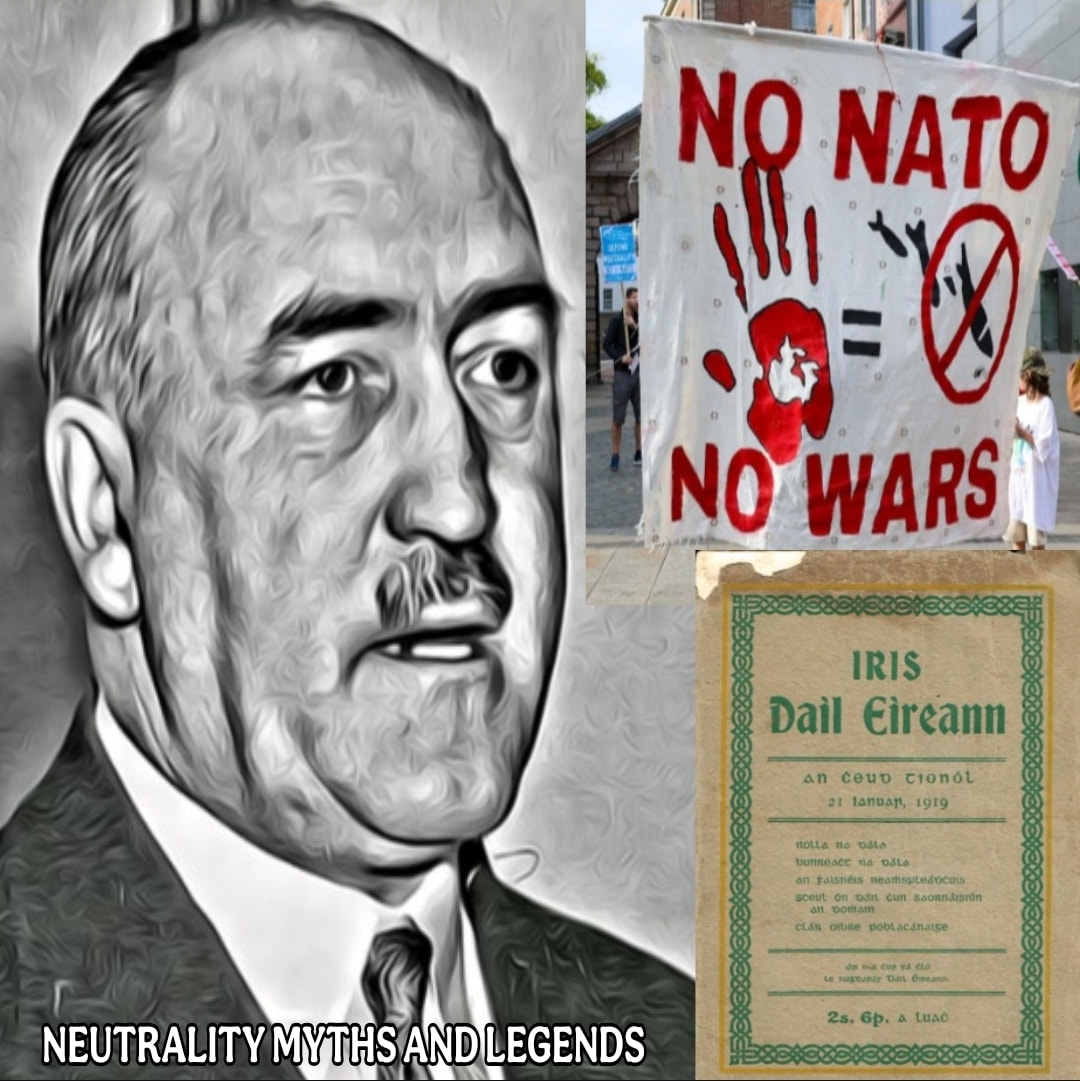
The current fashion is to elevate Frank Aiken into a secular saint of neutrality. We are treated to solemn references to UN speeches, nuclear non-proliferation initiatives, and the delicate art of “small state diplomacy” as if he is the architect of Irish neutrality.
The problem here is the methodology being applied, which is not dialectic.
When the material conditions are stripped away, what we end up with is random biography masquerading as analysis.
Neutrality is not a personality trait of a foreign minister. Neutrality is a structural condition shaped by economic alignment, class power, and geopolitical reality.
If we want to understand Irish neutrality, we have to begin not with Aiken’s speeches at the UN, but with the First Dáil of 1919.
The First Dáil declared a republic. Sovereignty and a Democratic Programme were the two pillars. Grounded in the people. This was anti-imperialism, a revolutionary programme in substance, not posture. Neutrality, in that revolutionary context, meant refusal to be absorbed into imperial strategy. It was a declaration of rupture.
What followed was not rupture completed, but rupture contained.
The Anglo-Irish Treaty partitioned the country and left six counties under British rule. Dominion status. An oath to the Crown. Treaty Ports. Partition copper-fastened. The national question amputated.
Neutrality is difficult to celebrate as some settled achievement when British sovereignty remains in the occupied six counties. The idea that the 26-county state achieved full neutrality while the territorial and constitutional integrity of the republic remained broken is not nuance. It is evasion.
Under de Valera, the state remained formally non-belligerent during the Second World War. Fine. But we should not confuse military non-participation with anti-imperial transformation. The economy remained deeply tied to Britain. The state repressed republicans and socialists. Class power remained in the hands of conservative nationalists, large farmers, business interests, and the Church.
Political independence did not become social transformation.
That warning had already been articulated by James Connolly, who argued that without economic and class change, independence would leave workers under native elites instead of foreign ones. The post-Treaty state secured space to manoeuvre diplomatically. It did not overturn, or aim to overturn the capitalist order.
By the time Aiken emerges as a diplomatic figure, the material trajectory of the vassal state was clear.
Ireland did not join NATO and it is misleading to imply Aiken single-handedly kept it out. Structural non-membership long predated any supposed personal intervention. Meanwhile, during his tenure, applications were made to join the European Economic Community. The country pivoted determinedly toward foreign direct investment and export-led growth. American capital was welcomed. The state oriented itself firmly within Western capitalism.
You cannot build your economy around Western capital, integrate into Western institutions, and align your growth model with transatlantic markets and then declare yourself structurally outside Western power.
This is calibrated participation, not neutrality.
Aiken’s speeches on nuclear non-proliferation at the UN, during Cold War times are purely symbolic, and are being remembered through nostalgia rather than scientific analysis. US interests were at the heart of Ireland’s involvement in Cold War diplomacy. Aiken, in his diplomatic correspondence positioned Ireland as reliably anti-communist within Europe. The state was not drifting toward socialist non-alignment; it was embedding itself within the Western capitalist core.
No foreign minister, however eloquent, was going to overturn the economic orientation of the state he represented.
This is the central point so often avoided: Aiken did not create Irish neutrality. He articulated and administered a version of it consistent with the class character and economic direction of the 26-county vassal state.
Elevating him into the posterboy of neutrality narrows history into biography. It obscures the deeper question: neutrality in whose interests? For what purpose? Within which system?
A partitioned state, economically dependent on Western markets, integrating into European and US capitalist structures, cannot claim the same anti-imperial orientation as a revolutionary assembly declaring sovereignty against empire in 1919.
The content changed, even if the word remained.
The issue with turning Aiken into a golden boy shows how low the intellectual bar is in Ireland. It narrows neutrality into legal technicalities and UN etiquette. It detaches it from reality and how imperialist power structure works.
What was consolidated in the 1950s and 60s was not revolutionary independence. It was Ireland’s position as a small, compliant node within the Western imperial-capitalist system.
Agency in Ireland operated within imperial structural limits determined by class interests and economic orientation.
History did not move because one man, Frank Aiken gave a good speech in New York. It moves because material conditions, class forces, and international structures create and constrain what is possible.
Real neutrality, the kind imagined in the spirit of the First Dáil, of 1919 would require more than careful positioning within imperial structures. It would require:
-
Reunification.
-
Economic independence from imperial centres.
-
Democratic control over resources.
-
Refusal to allow Irish territory, north or south, to serve imperial military infrastructure.
-
A break from structural dependency on Western capital.
So forgive the lack of applause when Aiken is presented as the Irish expression of Irish neutrality. From a working-class, anti-imperialist perspective, that narrative is ahistorical, and more like ideological tidying-up.
Neutrality cannot be understood through the elevation of one statesman. It can only be understood through the analysis of the Anglo-Irish Treaty, and British domination it chose not to confront.
Until that is faced honestly, the story of Irish neutrality will remain less an analysis, and more a comfort based in ignorance.