One of the few good things to come out of the current wave of protest about fuel prices, is clarity.
The vacuum created by self-identified left organisations exposes a deeper truth about class politics in Ireland and across Europe. It has revealed that much of what passes for the left today is, in reality, very detached from the material interests and lived experiences of the working class.
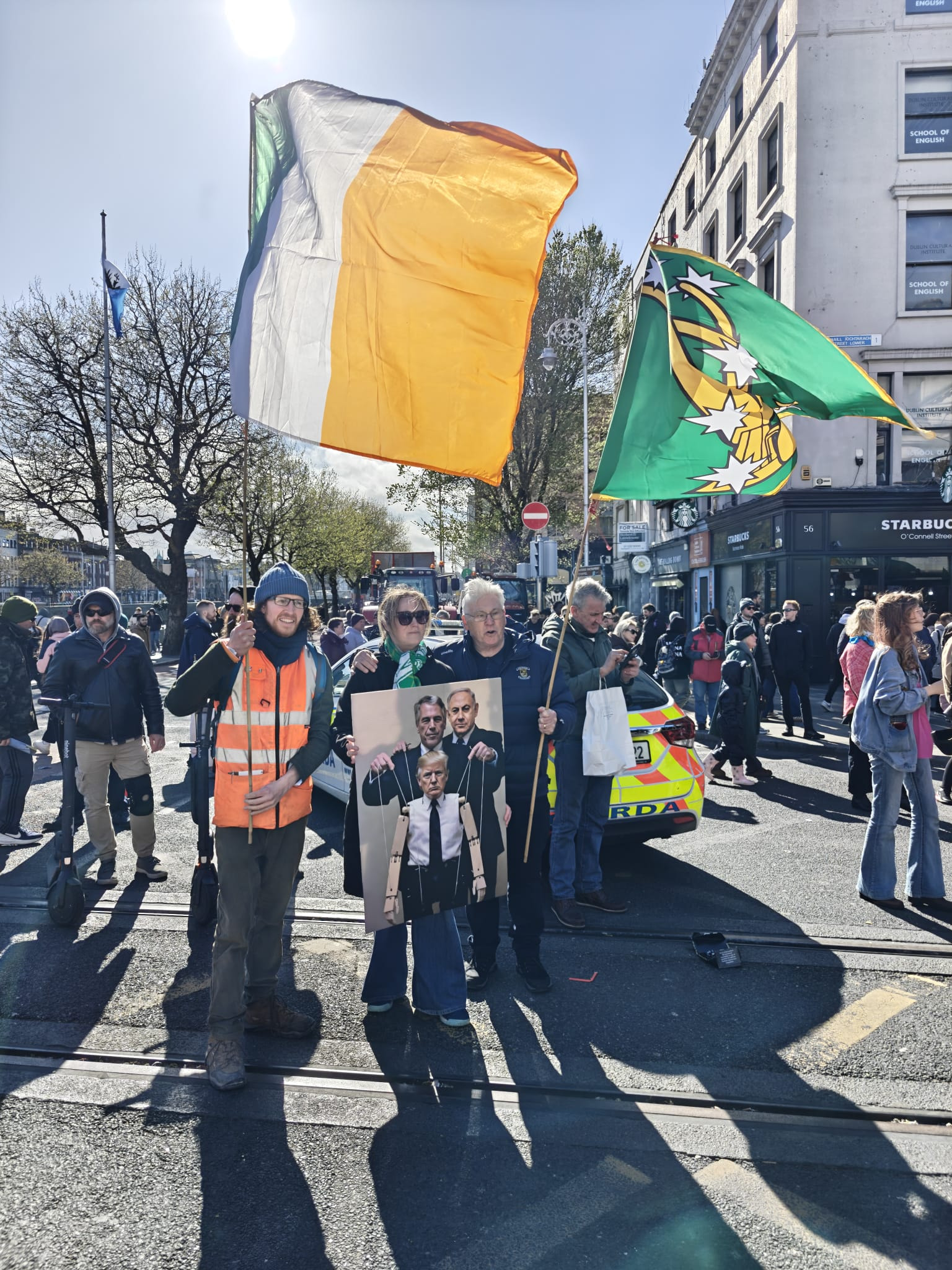
The recent mobilisation around fuel protests has been widely dismissed and labelled in certain circles as far-right. This misleading narrative has been amplified through a narrow focus on a small cohort of annoying individuals and bandwagon agitators rather than a serious engagement with the broader social forces at play. In doing so, self-identified left groups, including segments of the Palestinian solidarity movement have failed in their most basic responsibility which is to analyse class dynamics and engage with the masses where they are.
This failure reflects the class character of these organisations themselves. To be meaningfully left-wing is not a matter of rhetoric. It is defined by a clear opposition to capitalism and a commitment to the revolutionary transformation of society. Yet across Ireland, and Europe, we see organisations that avoid even the language of class struggle. Terms like “working class,” “ruling class,” and “capitalism” are conspicuously absent from their discourse. This ideological retreat explains not only the absence of many who think they are left at fuel protests, but also by the absence, and inability of a vanguard party in Ireland to lead the rightfully angry masses.
What, instead has emerged, is a politics of management rather than transformation. Amongst the “opposition” (including its base), poverty is not seen, nor confronted as, a structural necessity of capitalism. It is regarded as a social problem to be mitigated.
Seeing the so-called left ardently defend food banks, soup kitchens, NGOs, and state-funded charities and continue to present these as solutions, is illustrative of the pathetic state of affairs we are dealing with, particularly in the capital city of Dublin. The championing and defense of tools of pacification to alleviate the symptoms of capitalism to preserve the system that produces them is not funny.
The working class has long understood this contradiction through lived experience. The poorest in our society know how they are perceived. Objects of pity, problems to be managed, passive recipients of charity rather than agents of change. The snobbery displayed toward those who do not speak, dress, or behave according to middle-class norms only reinforces this divide. This was also strikingly clear to us when we occupied grounds at the UCD Break the Academic Chains of Zionism encampent for 132 days running (from September 2025 to January 2026). Bar the Peadar O’Donnell Socialist Republican Forum, support from those claiming to be revolutionaries was thin on the ground. Garda brutality was also ignored through the careful containment of the liberal Pal movement, similar to how it is always conveniently ignored when working-class groups and communities face the crack of the police baton, or worse. Not all victims of Garda abuse are equal.
This same contradiction is evident in the response to recent protests. Rather than engaging with the legitimate grievances of working people struggling under rising costs and declining living standards, elements of the self-identified left have chosen dismissal, moral superiority and moral condemnation. In doing so, they have abandoned the field to opportunists and reactionaries.
It is also necessary to be clear-eyed about the class composition within the fuel protest movement. Not all who jumped on a Massey Ferguson in such protests are part of the working poor. The presence of relatively well-off individuals including those with access to significant capital points to the complexity of the moment. Their bourgeois demands, such as fuel price caps for a select few reflect immediate economic interests, but they do not in themselves constitute a revolutionary programme. In fact, this is the crux of the matter: there is no clear or coherent message.
For revolutionaries, bourgeois demands are not the end point. They are only the starting point. Thus, our job is not to outright reject the fuel protest movement, or romanticise them uncritically. It is to intervene, to organise and raise political consciousness. It is to connect immediate struggles to the broader reality of capitalist exploitation and imperialist domination. It is to transform spontaneous protest into disciplined, class-conscious movement.
This requires a break from the NGO model of politics and a return to mass line organising rooted in the working class. It requires engaging with people as they are, not as we might wish them to be. It requires recognising that revolutionary potential does not emerge from purity, but from contradiction.
Anti-imperialism cannot be separated from class struggle. The same system that exploits workers at home enacts barbaric cruelty on West Asia, on Venezula, on Cuba, on African countries. Standing with oppressed peoples in faraway countries while ignoring the conditions of the domestic working class is to misunderstand both.
If the current moment reveals anything, it is that the self-identified left that refuses to confront capitalism, that distances itself from the working class, and revolutionaries, and that prioritises respectability over struggle, is not a left capable of any change.
We urgently need working-class power guided by revolutionary theory and practice, that is committed to the overthrow of the system itself. So while the contradictions are sharpening, the question now is whether or not we are prepared to meet them.