Palestine and the Politics of Solidarity.
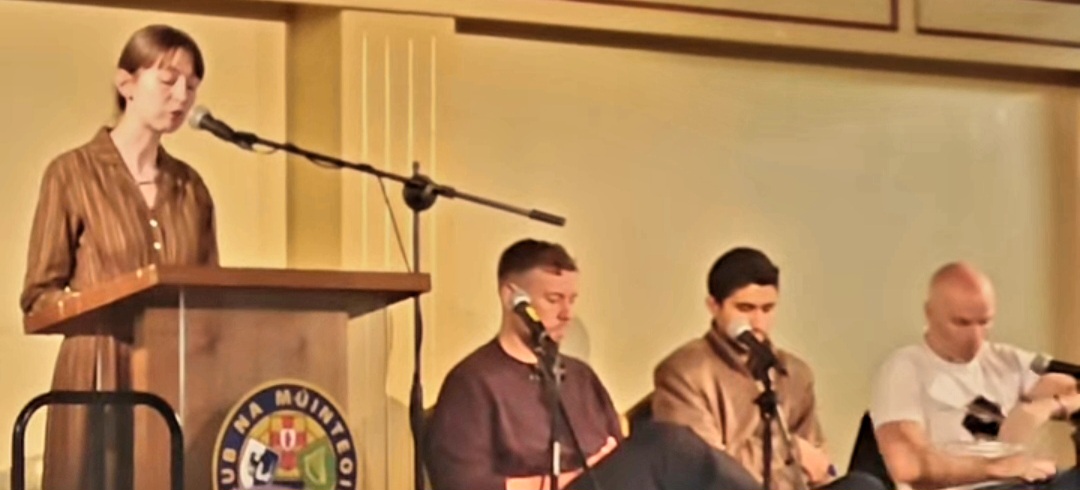
On 16 June, the Teachers’ Club in Dublin hosted a discussion entitled “Palestine and the Politics of Solidarity”, organised by OR Books.
The panel comprised investigative journalist and author Matt Kennard, acclaimed Irish novelist Sally Rooney, comedian and activist Tadhg Hickey, Palestinian journalist Abubaker Abed to discuss the genocide on Palestine, the criminalisation of Palestine Action under the Terrorism Act, and what meaningful activism demands in the face of Zionism.
The evening was not confined to a discussion on genocide. The issues of state power, and US imperialism arose, while the question that has confronted every liberation movement throughout history: is symbolic protest enough, or must solidarity become organised resistance.
A central focus of the discussion was the increasing use of anti-terror legislation against Palestine solidarity activists, particularly the Filton 4 of Palestine Action in England. Speakers Sally Rooney and Matt Kennard concluded that this reflects a broader trend across Britain and Europe, where governments have expanded national security powers to suppress movements that materially challenge military production and corporate complicity in service of the Zionist entity.
The panel argued that while Western governments frequently defend freedom of speech in principle, they are criminalising activism when it threatens Zionist economic interests underpinning foreign policy. Direct action targeting arms manufacturers like Elbit, military suppliers, or institutions linked in any way to the illegal occupation of Palestine represents a challenge not simply to individual corporations but to the political economy of imperialism and Zionism itself.
Throughout history, states have consistently distinguished between protest they can put up with and resistance that disrupts power. Peaceful demonstrations may be permitted, even road blocks for an hour or two, but organised, disciplined action capable of interrupting the flow of capital, weapons or logistics has been met with repression. Palestine solidarity is increasingly reaching this threshold.
Author of The Racket, Matt Kennard talked about the genocide by situating Palestine within a global system of US, EU and British imperialism rather than treating it as an isolated conflict. He implied that Israel functions as a strategically important ally of Western powers in West Asia, receiving extensive military, diplomatic and financial backing from the United States and its Zionist allies. This support cannot be understood separately from broader Zionist interests in maintaining Western influence across the region.
Discussions or activism centred solely on humanitarian concerns risk obscuring the structural forces that sustain the illegal occupation, according to Abubaker. He relayed that while humanitarian appeals expose immense human suffering, he asked us to think more about why that suffering continues despite overwhelming international condemnation.
The answer he argued is that the issue is fundamentally political and economic. Western powers continue to support Israel because it advances broader strategic interests. Consequently, the repression of Palestine solidarity movements in Britain, Ireland and elsewhere cannot be separated from the same imperial system that supports Zionism.
One of the most provocative discussions of the evening concerned the limits of symbolic protest. While acknowledging the importance of demonstrations and awareness campaigns, including those organised by organisations such as the Ireland Palestine Solidarity Campaign (IPSC), the panel questioned whether marching alone is capable of ending an illegal occupation or even slightly disrupting the political structures that sustain it.
The speakers argued that the British, and Irish governments accommodate symbolic dissent while resisting any movement that imposes material costs on businesses, corporations and institutes, or indeed reputational damage. Historical struggles against colonialism, apartheid and imperialism were cited as examples where victories were certainly not secured through appeals to morality but through organised resistance and mass mobilisation.
Abubaker challenged the audience to seriously consider whether solidarity should remain confined within forms acceptable to the free state or develop into movements capable of materially challenging Zionist power. He suggested Google several times as a good target.
One of Matt Kennard’s responses to a question which asked, where are the unions, highlighted the relationship between Britain’s trade unions and the Labour Party. Kennard said that many of Britain’s largest unions are institutionally tied to Labour thus they are captured. Rather than functioning as independent organs of working-class struggle, he emphasised that the trade union bureaucracy in Britain is deeply invested in parliamentary politics and maintaining influence within Labour. This relationship, of course, is rooted in history. The Labour Party was founded in 1900 by the trade union movement as the Labour Representation Committee, and affiliated unions continue to occupy a central place within the Labour party’s organisational and financial structures. Today, unions remain Labour’s largest financial backers. According to Electoral Commission data compiled by the House of Lords, affiliated unions donated approximately £64.8 million to Labour between 2010 and 2015 alone. Unite contributed almost £25 million, while UNISON, GMB, USDAW and the CWU each provided millions more through affiliation fees and political donations to the Labour Party. More recent analyses of Electoral Commission records estimate that Labour received around £142 million from trade unions between 2010 and 2022.
Kennard was able to show that this institutional relationship creates powerful incentives for union leaderships to prioritise Labour’s electoral strategy over independent industrial struggle. While many rank-and-file trade unionists have expressed strong solidarity with Palestine, national leaderships have generally been more cautious about organising disruptive industrial action or campaigns that could directly challenge British foreign policy or the arms industry.
This section of the discussion highlighted an enduring tension within the labour movement both in England and here in Ireland. Should unions primarily seek influence through parliamentary politics, or should they build independent working-class power capable of confronting both employers and the state?
The panel also examined international law and anti-colonial struggle. Speakers argued that international legal principles recognise the right of peoples living under aparthied, domination or foreign occupation to struggle for self-determination. Western governments often apply international law selectively, invoking it against geopolitical adversaries like Russia and China while failing to hold allies to the same standards. This selective application undermines the credibility of the so-called “rules-based international order” and reveals how international institutions are being shaped by Zionist power rather than applied consistently.
Perhaps the clearest message emerging from the evening was that solidarity is not charity, a mantra we hold dearly. Solidarity means recognising that struggles against colonialism, imperialism and capitalism are interconnected. It requires not just sympathy with oppressed peoples but participation in movements capable of confronting the political and economic systems that produce oppression.
The discussion therefore challenged listeners to think beyond humanitarian concern and towards organised political action. Whether through workplace organising, direct action, political education or international campaigning, the panel argued that genuine solidarity must seek to interrupt the structures that enable genocide rather than merely witness their consequences. The event ultimately presented Palestine as one of the defining anti-imperialist struggles of our time. It called upon those committed to anti-Zionism and internationalism to move beyond symbolic expressions of support and towards building movements capable of challenging imperialism wherever it manifests itself.
As the discussion repeatedly emphasised, history has rarely been changed by appeals to conscience alone. It has been changed by organised people acting collectively to transform the balance of power.
The discussion also raised broader questions about direct action and the meaning of resistance. If demonstrations express public opinion, direct action seeks to interrupt the institutions through which power operates. Arms factories like Elbit, universities, banks and corporations are not politically neutral. They are embedded within the cruel system that sustain and normalise military production for genocide.
This perspective got me thinking about recent debates surrounding the UCD “Break the Academic Chains of Zionism” encampment. Rather than allowing the encampment to develop as an experiment in sustained resistance and political education, sections of the wider movement blanked it, dismissed it, spread malicious rumours about organisers or distanced themselves before it even had an opportunity to establish itself. This reflects a broader strategic weakness within sections of the solidarity movement. Too often there is a failure to distinguish between symbolic protest and direct, sustained confrontation with institutional power. If universities are understood as benevolent, or even benign places of learning, occupations appear unnecessary. But if universities are recognised as institutions integrated into corporate funding, military research, elite ideological production and partnerships with companies implicated in genocide, then challenging them becomes an essential, and obvious part of confronting imperialism and Zionism.
The question turned quickly to whether the movement is prepared to support forms of resistance that require sacrifice, and that genuinely challenge power, or whether it (un)consciously limits itself to forms of protest that remain acceptable to existing institutions. A movement that discourages initiative whenever activists move beyond symbolic politics will inevitably reproduce the very limitations criticised throughout the evening.
Universities cannot be viewed as educational institutions for the advancement and progress of humanity. Go into any university in Ireland today and you will see that they are centres of corporate partnership, military research and ideological production. Challenging those relationships requires more than symbolic protest, like the encampments of the summer of 2024. Direct action should not be viewed only as disruption. Direct action is as much about political education in practice as it is about disturbing power for an hour or two, or even a week. The 132 Day Break the Academic Chains of Zionism Encampment at UCD between September 2025 and January 2026 exposed institutional relationships that remained hidden in the summer 2024 camp. Creating spaces in which participants from all walks of life collectively develop organisational experience, strategic understanding and political confidence is a real threat to imperialist power. Those who object to that are clearly not, or never going to be on our side, ie on the anti-imperialist, pro-resistance side.
Interestingly, one of Matt Kennard’s most important arguments concerned the need to construct independent institutions rather than relying exclusively upon those already integrated into existing systems of power. Alternative media form one part of this project, but the principle extends much further. Independent political education, workers’ organisations, community institutions, people’s assemblies, mutual aid networks and democratic forms of collective organisation all contribute to building the social capacity required for sustained resistance. The 132 Day BACZ encampment at UCD reflected precisely this understanding.
The decision to name the occupation the “Leila Khaled School” was not symbolic branding. The encampment sought to become more than a protest. It functioned as an alternative university in which participants collectively studied imperialism, revolutionary history and theory, direct action, and political organisation.
Coincidentally, this also reflected Kennard’s broader argument about constructing parallel institutions. Resistance cannot depend solely upon institutions already embedded within the structures of imperial power. Every successful liberation movement has developed its own means of communication, education and organisation. Independent media is only one aspect of that process. Alternative educational spaces are equally necessary because they cultivate the political consciousness and organisational capacity required for sustained struggle. The Leila Khaled School attempted to put this principle into practice. It demonstrated that direct action is in and of itself educational. Participants did not simply huddle round a camp fire together. We studied together, we debated strategy, we learned from one another and we collectively developed the practical skills required for long-term political organisation. Our encampment became more than an occupation of physical space on the front lawn of UCD. Contrary to it being called the N11 bus camp by both Orla Feely and UCD BDS, the 132 Day encampment became an alternative educational institution, challenging both the political assumptions and institutional authority of the university itself.
Alternative education is itself a form of resistance, as Paulo Friere and others have signalled. It develops the knowledge, discipline and organisational confidence necessary for movements capable of confronting existing structures rather than begging or appealing to them. Political education cannot remain confined to books, lecture theatres, or Zooms, just as resistance cannot remain confined to weekly or monthly demos. Both must become living practices through which ordinary people collectively acquire the knowledge, skills and capacity to transform society.
The clearest lesson emerging from the evening was that solidarity is not charity. Solidarity means recognising that struggles against colonialism, imperialism and capitalism are interconnected. It requires not only sympathy with oppressed peoples but participation in movements capable of confronting the political and economic structures that reproduce oppression. So the challenge facing the Palestine movement is not to become larger but to become deeper. It has to root itself within working-class communities rather than political subcultures. It must build independent institutions rather than relying exclusively upon existing ones. It must understand political education as essential to resistance rather than supplementary to it. Above all, it must recognise that imperialism is defeated through educated, organised people developing the collective power necessary to transform society.
The lesson running through every contribution on Tuesday evening, the 15 June, Bloomsday, was that power concedes nothing voluntarily. Neither Conservative nor Labour governments in Britain have shown any willingness to fundamentally alter their relationship with Israel. Appeals to successive governments in Ireland, England, France, Germany, US… or wherever, regardless of which party occupies office, have failed. If state institutions remain committed to Zionist interests, then movements seeking justice for Palestine must develop sufficient social power outside those institutions to force political change.
Palestine can only become a successful movement if it develops into a broad working-class anti-imperialist, anti-Zionist movement capable of building independent institutions and confronting power materially, not symbolically.
Appeals to conscience are futile. Only organised movements capable of building institutions, educating their members, disrupting systems of exploitation and creating a new balance of power can create real, meaningful change.
The future of Palestine solidarity may well depend upon whether it remains a campaign of protest, or develops into a genuinely popular anti-imperialist movement capable of doing precisely that.