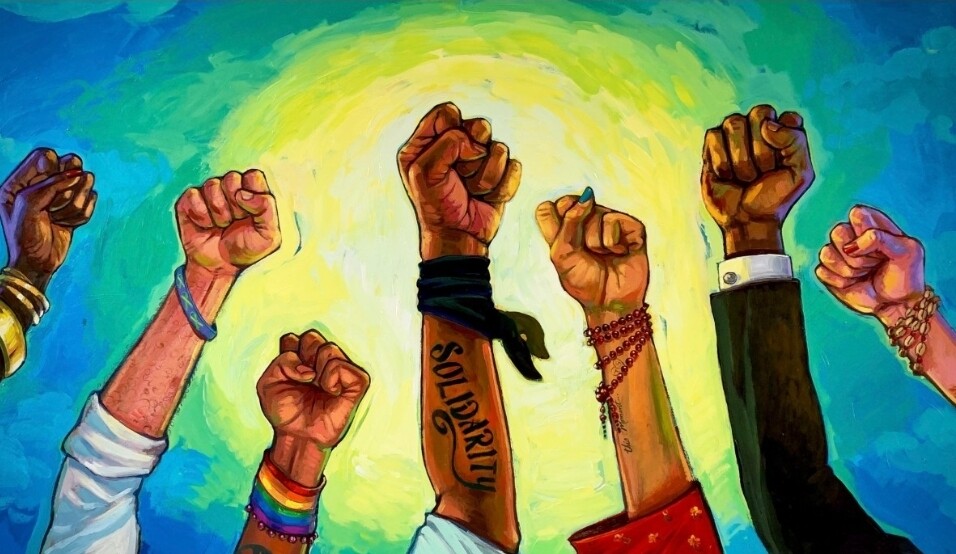
Following the recent barbaric news that the Knesset passed a law for the death sentence of Palestinian prisoners only held captive by the Zionist entity, a swell of anger and activism has ignited once again in the Palestinian movement.
This weekend saw a rally in Dublin for the release of detained Palestinian healthcare workers in “Israeli” jails.
In Ireland, we have many sectors of workers (and other identity groups) who stand for Palestine. They are all clearly moved by real outrage and compassion, in particular for their colleagues and fellow humans with whom they find common ground, be that in the nature of their profession, or other recognisable identity.
But a question that we need to ask ourselves in our respective “X for Palestine” groups is, what shapes the boundaries of our concern? Why do we recognise certain lives more readily than others? And what does it reveal about our political imagination when solidarity is so often organised along professional or identity lines?
If we look closely, we might begin to notice a pattern. Why is it that advocacy so frequently takes the form of one group speaking for itself, rather than alongside others? Why has the Pal movement fragmented into parallel tracks? Healthcare workers here, educators there, academics there, students there, etc. each fighting urgently, yet often separately? Are we really building power, or are we reproducing classist divisions that structure the world we claim to resist?
These are not comfortable questions, especially for those committed to justice. But discomfort is often the beginning of critical awareness. If our politics is shaped within a neoliberal framework where attention is compartmentalised, where certain victims must compete for visibility, then does our activism begin to mirror a marketplace? In such a space, whose suffering becomes most “legible”? Whose story is amplified, and whose fades into the background? And what happens when recognition itself becomes a kind of currency?
We might also ask, when we prioritise certain identities, eg healthcare workers, teachers, students, or others, are we unintentionally creating hierarchies of worth? Even if we do not say that one life matters more than another, do our actions imply it?
When campaigns highlight those who are easier to empathise with (those who fit familiar or respected roles) what happens to those who do not? The unemployed, the undocumented, the socially excluded. Where do they appear in this landscape of solidarity?
This is not to dismiss the importance of the Palestinian movement. Rather, it is to question the limits of how struggle is framed. If each group organises primarily around its own identity, can we ever arrive at a truly collective movement, never mind collective politics? Or do we risk becoming isolated constituencies, each advocating within our own silo, competing, however unintentionally, for recognition and support?
And what of power? Does a movement that compartmentalises victims of Zionism really challenge the structures that produce injustice, or does it leave them intact?
If the root causes of suffering, oppression, war, exploitation, displacement, repression cut across all identities, then why do our movements so often remain confined within them?
What would it mean to organise not as healthcare workers or teachers or academics, or students or even mothers alone, but as part of a broader human struggle against Zionism and imperialism?
Perhaps the question that needs to be asked is if we are we seeking inclusion within the existing order, or transformation of it?
If our activism stops at elevating certain voices without challenging the system that renders others invisible, have we gone far enough? Or have we simply learned to navigate inequality more effectively, rather than dismantle it?
A different path is possible, but it begins with rethinking solidarity itself. Can we imagine a politics that does not sort people into categories of greater or lesser urgency? Can we build movements that refuse to rank suffering, that see dignity not as something to be earned through identity or profession, but as something inherent?
These are not questions with easy answers. But they are necessary ones. Because without asking them, we may continue to act with the best of intentions while remaining confined within the very limits that prevent real or meaningful change. The danger with selective outrage, or selective solidarity is that it is exclusionary. And what does it say when a call for the release of some tortured, abused Palestinian prisoners is made, but not ALL?