Róisín McAleer
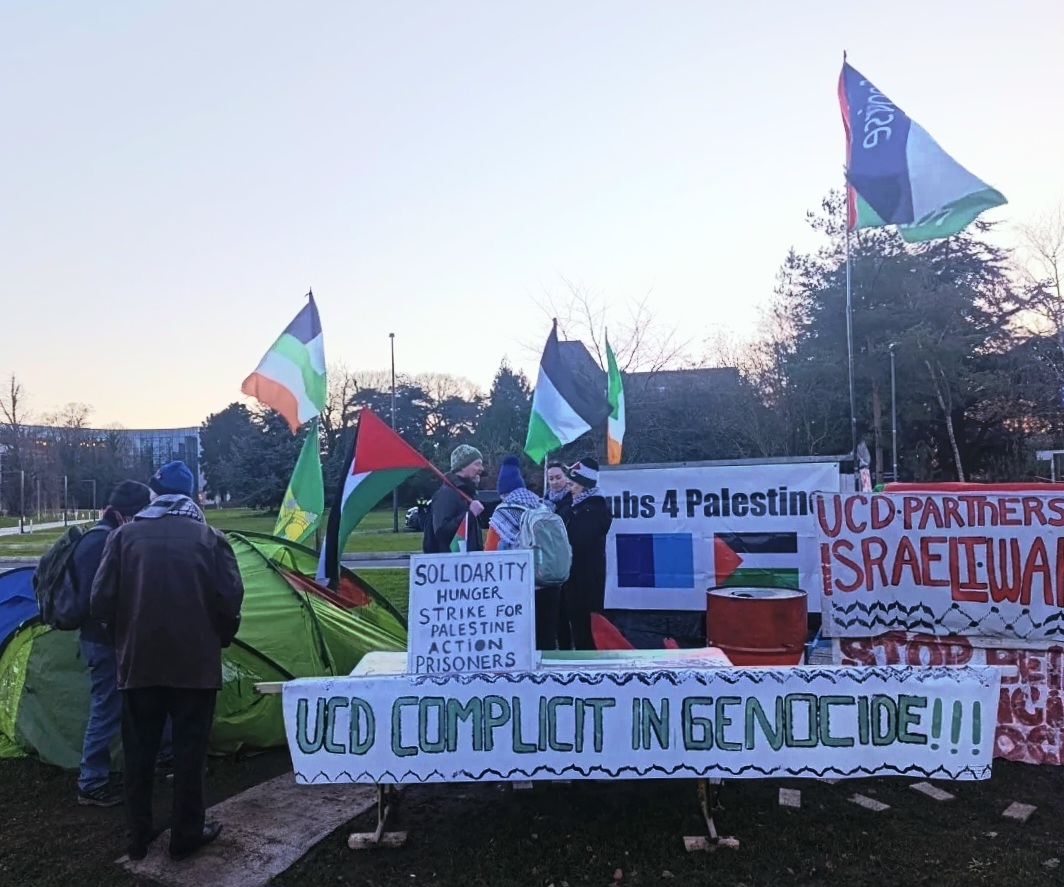
As of St Stephen’s Day 2025, the Break the Academic Chains of Zionism encampment at University College Dublin has reached 114 days. Its significance lies not in the fact that it is the longest running university encampment in Ireland, but in the clarity it has produced.
Over this period, the encampment has revealed who is willing to stand in solidarity, the limits of political understanding within the Irish left, and the nature of education under capitalism in Ireland.
One of the most important outcomes has been the identification of allies and the exposure of those whose radicalism exists only on paper. Such clarification should not be mistaken for division. Political struggle inevitably produces ruptures. What is genuinely divisive is not honest confrontation but the replication of oppressive behaviours: silence from friends in the face of institutional pressure, condescension from once considered allies, in place of engagement, and the substitution of procedural critique for actual solidarity.
I also write from the perspective of a secondary-school teacher of History. From inside the education system, it is clear that Irish schooling and universities are structurally incapable of teaching history through an anti-imperialist lens. Empire is softened, colonialism historicised, and class struggle absent. Students are taught to learn key terms, not context; dates, not power; chronology, not historic consciousness.
Within this framework, a particular figure emerges: the academic radical. These are individuals who write and talk extensively about oppression while remaining comfortably insulated from it. From the safety of offices, conferences and panels, they scrutinise the language of those in struggle with remarkable intensity. Every statement is proofread, every turn of phrase questioned, every theoretical nuance catalogued. Meanwhile, engagement with lived struggle is optional. Lived experience? Unnecessary. Risk? Unwelcome.
This preoccupation with policing language is a mechanism for maintaining authority while avoiding responsibility. It allows one to appear radical without ever confronting institutions, power or repression directly.
The encampment has rattled this carefully cultivated comfort precisely because it never asked permission, and because we insist that politics be practised, not observed from a safe distance.
Over the last 4 months, our encampment has functioned as a living classroom. Learning occurs through organisation, sustained commitment, and the disciplined enactment of politics, rather than through credentials or professional recognition.
This is evident in our most recent actions. The encampment is currently undertaking a 24-hour rolling solidarity fast in support of the five demands of the hunger strikers imprisoned in England. Volunteers are placing their body into struggle, connecting our struggle to a history of hunger, sacrifice and resistance.
A screening of Hunger, Steve McQueen’s film on Bobby Sands and the 1981 hunger strike, further reinforced this connection. Sands’ words, “Our revenge will be the laughter of our children” continue to resonate because they were forged in struggle, not articulated from comfort. One struggle. One fight.
The value of the Break the Academic Chains of Zionism encampment is in the unity of theory and practice. Lenin himself argued that political consciousness develops through struggle and organisation, not through detached observation. The encampment has insisted on this principle, to the discomfort and embarrassment of those who prefer critique from a safe distance.
This contrast became particularly clear when two students involved in the encampment were threatened with disciplinary hearings by UCD management just two days before the Christmas holidays. The response from their peers in the Students Union is revealing. Those operating under the banner of UCD BDS choose silence over solidarity, prioritising appearances and institutional convenience over concrete support. When repression becomes real, performative radicalism evaporates.
By contrast, consistent and principled support has come from comrades in the Six Counties, particularly the Peadar O’Donnell Socialist Republican Forum. Their politics are informed by direct experience of occupation and struggle. Without exaggeration, analysis forged under such conditions demonstrates a sharper understanding of power, risk and resistance than that developed in the relative comfort of the Free State.
As Ghassan Kanafani argued, the Palestinian struggle is inseparable from global anti-imperialist resistance. The encampment has taken this seriously, linking Palestine, Ireland, political prisoners, and imperial structures through sustained practice rather than rhetorical alignment.
After 114 days, the encampment stands as an example of political education grounded in struggle. It has clarified alliances, exposed the limits of respectable radicalism, and demonstrated that genuine learning about imperialism does not originate within formal institutions. In this sense, its contribution is not only political but educational. A model rooted in participation, risk, and collective responsibility rather than abstraction or careerist performance.
And for those who continue to observe from offices and seminar rooms, scanning our statements for errors or theoretical “impurities”…the encampment will continue regardless. Their red pens will not stop our collective struggle, their tone critiques will not halt solidarity and their comfortable analyses will be no substitute for action. History is being written at Break the Academic Chains of Zionism encampment at UCD, not in the inboxes of academics, and the lessons we learn here are not negotiable.