Róisín McAleer
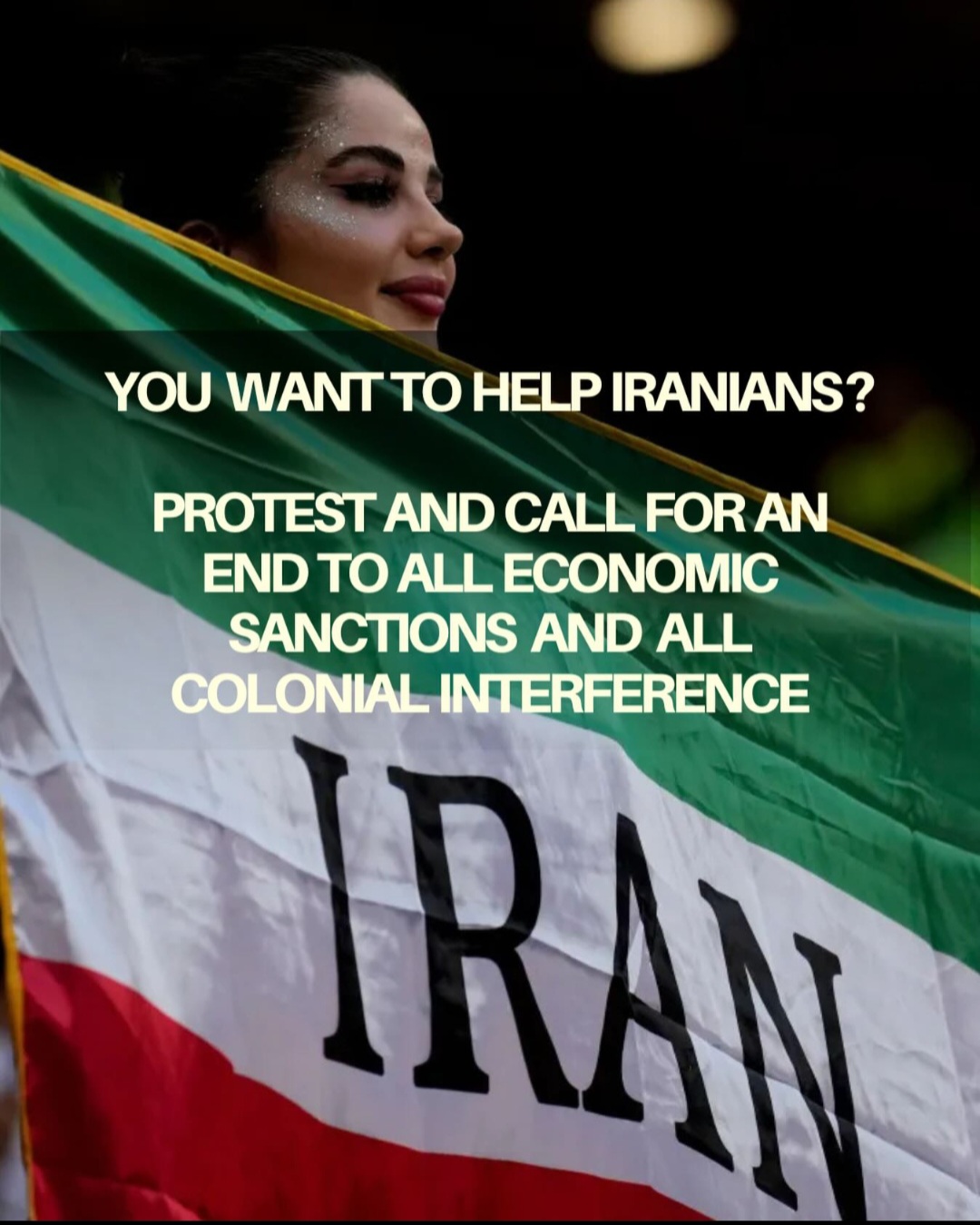
Imperialist propaganda operates via a range of robust structures that shape political “common sense”… to manufacture consent for its own interests. Its effectiveness lies in normalising certain narratives while rendering others marginal or unintelligible. Even critics of neoliberalism and empire can reproduce imperial outcomes. The Western reception of the “Woman. Life. Freedom” discourse and its amplification by seeming progressive intellectuals, feminist organisations, diaspora networks, and exile formations shows how this process works in practice.
The rapid integration of Woman. Life. Freedom. into Western moral and political discourse occurred through established channels: corporate media, NGO advocacy, philanthropic funding, and liberal civil society. These channels do not simply transmit information. They select and frame events in ways consistent with imperial priorities. Movements emerging in states targeted by Western power are routinely interpreted through a moral lens, a good verus bad dichotomy, an oppression versus freedom binary, all the while pushing historical contexts such as sanctions, economic warfare, and regime-change pressure to the periphery.
Western left intellectuals and feminist groups often accept this framing because it resonates with liberal-universalist assumptions that persist even within anti-neoliberal critique. Figures who are outspoken critics of austerity, militarism, or financialisation show a tendency to nonetheless endorse Woman. Life. Freedom. narratives in a register that treats Western media accounts as neutral and universalises “human rights” without situating them in the concrete terrain of imperialism. Sanctions, one of the most decisive forms of imperialist violence, are rarely foregrounded as a primary determinant of social suffering, despite their well-documented effects on wages, employment, health systems, and social reproduction. The result is a selective anti-imperialism. Western coercion is opposed in principle, yet movements whose dominant media framing functions to legitimate that violent coercion are embraced in practice. This contradiction does not register as hypocrisy within liberal ideology. It registers as moral consistency, because the terms of legitimacy have already been set by imperial power.
Central to this process is the co-opted diaspora mediation layer that translates unrest inside Iran into narratives consumable and easily digested by Western audiences. The class character of this layer is decisive. The most visible and resourced diaspora actors are predominantly *middle- and upper-middle-class and integrated into professional, academic, media, and NGO sectors of the imperial core.**Their political sensibilities are shaped by liberal individualism, civil-society advocacy, and platform-driven visibility rather than by proletarian organisation or anti-imperialist struggle. This class position shapes both the demands articulated and the forms of “solidarity” performed.
Diaspora fundraising associated with Woman. Life. Freedom. exemplifies this dynamic. Funds raised in the imperial core are not directed toward building mass organisations, labour capacity, or durable political structures inside Iran. Nor are they channelled to highlight or combat crippling, coercive Western and Zionist-imposed sanctions. Instead, resources flow into media campaigns, billboards, social-media amplification, cultural events, lobbying, and public relations. These acts privilege spectacle over organisation, recognition by Western institutions over accountability to the working masses most affected by imperialism, and identity politics over power. The movement becomes legible within Western ideological space while remaining disconnected from class struggle on the ground.
The infrastructures through which this occurs (crowdfunding platforms, social-media corporations, philanthropic norms, legal frameworks, and corporate media) act as ideological filters. Narratives that align with imperial interests circulate easily; those that foreground sanctions as class violence, link women’s oppression to economic warfare, or challenge regime-change politics struggle for visibility. Anti-imperialist perspectives are excluded not primarily by repression but by structural invisibility. What results is a substitution of representation for organisation. When diaspora spokespersons speak about the masses and for the masses, but not as the masses, who benefits?
The objective outcome is the strengthening of liberal opposition currents compatible with imperial pressure strategies. Even when Western feminists or self-identified left intellectuals oppose sanctions abstractly, their endorsement of movements framed within imperial media ecosystems contributes to a moral climate that sustains those sanctions. This produces political confusion. The same states imposing collective punishment appear as allies of liberation. The same intellectuals denouncing empire appear alongside narratives that reproduce it. Confusion is inevitable, but of course, functional.
Imperialism thrives not only on force but on ideological fog, in which contradictions are normalised and political clarity dissolves.
Liberal feminism, severed from political economy, becomes an especially effective transmission vector. By framing women’s oppression primarily as cultural or legal, it obscures the material violence of sanctions, underdevelopment, and geopolitical domination. Western feminist organisations can mobilise genuine concern while remaining structurally aligned with imperial power, reproducing a familiar script in which women’s suffering is moralised while the imperial causes of that suffering are rendered invisible, or at best, secondary.
A parallel contradiction emerges among exile formations that continue to claim communist or socialist identities while operating largely outside Iran’s material and political realities. The contemporary posture of the Tudeh Party illustrates the problem. Historically rooted in Iran’s communist movement, its present existence is largely that of a tiny exile formation, geographically and politically removed from the Iranian working class. This distance is not just spatial, it is ideological. Operating within Western political environments, such Western compliant “Marxist” groups increasingly reproduce the same discursive limits that shape liberal opposition, despite their radical self-description.
The decisive test of any organisation claiming communist politics under conditions of imperial pressure is its position on imperialist coercion, and above all, sanctions. Sanctions are not a secondary policy dispute. Sanctions are a central weapon of class war. They collapse real wages, destroy productive capacity, erode social services, and intensify precarity, with women bearing a disproportionate burden. For Iranian workers, sanctions are experienced as daily immiseration. Inflation, unemployment, shortages, and the systematic weakening of Iran’s bargaining power and currency.
Any organisation claiming solidarity with Iranian workers while failing to centre an uncompromising demand for the total and unconditional lifting of Western and Zionist imposed sanctions reveals a rupture between rhetoric and material analysis. Exile “communism” that remains silent, ambiguous, or secondary on sanctions while aligning itself with narratives propagated by sanctioning powers functions objectively as a left cover for imperialism. This is what we mean when we use the terms: fake left, self identified left, or liberal left.
The irony is sharp. Organisations invoking socialism while operating within imperial ideological space reproduce the same substitutionism found in liberal diaspora activism. They speak in the name of the working class while remaining structurally disconnected from it, privileging recognition by Western audiences over accountability to workers enduring economic warfare. In doing so, they contribute to the same confusion of the masses, blurring the line between anti-capitalist politics and imperial-compatible dissent.
If the aim is genuinely to assist the Iranian working class, the political priority cannot be symbolic alignment with Western-endorsed protest narratives or moralised abstractions of “freedom.” It must be organised opposition to the mechanisms strangling Iran’s economy: sanctions, financial isolation, and imperial attack. Without this, claims to communism collapse into empty signifiers, radical in language, reactionary in effect.
We must insist that emancipation cannot be articulated within an ideological field structured by empire. Without grounding in class struggle, national sovereignty, and uncompromising opposition to imperialist coercion, Western expressions of solidarity risk become instruments of domination. Political clarity requires breaking with the Zionist dominated propaganda machinery that converts dissent into spectacle and weakens our anti-imperialist movement.